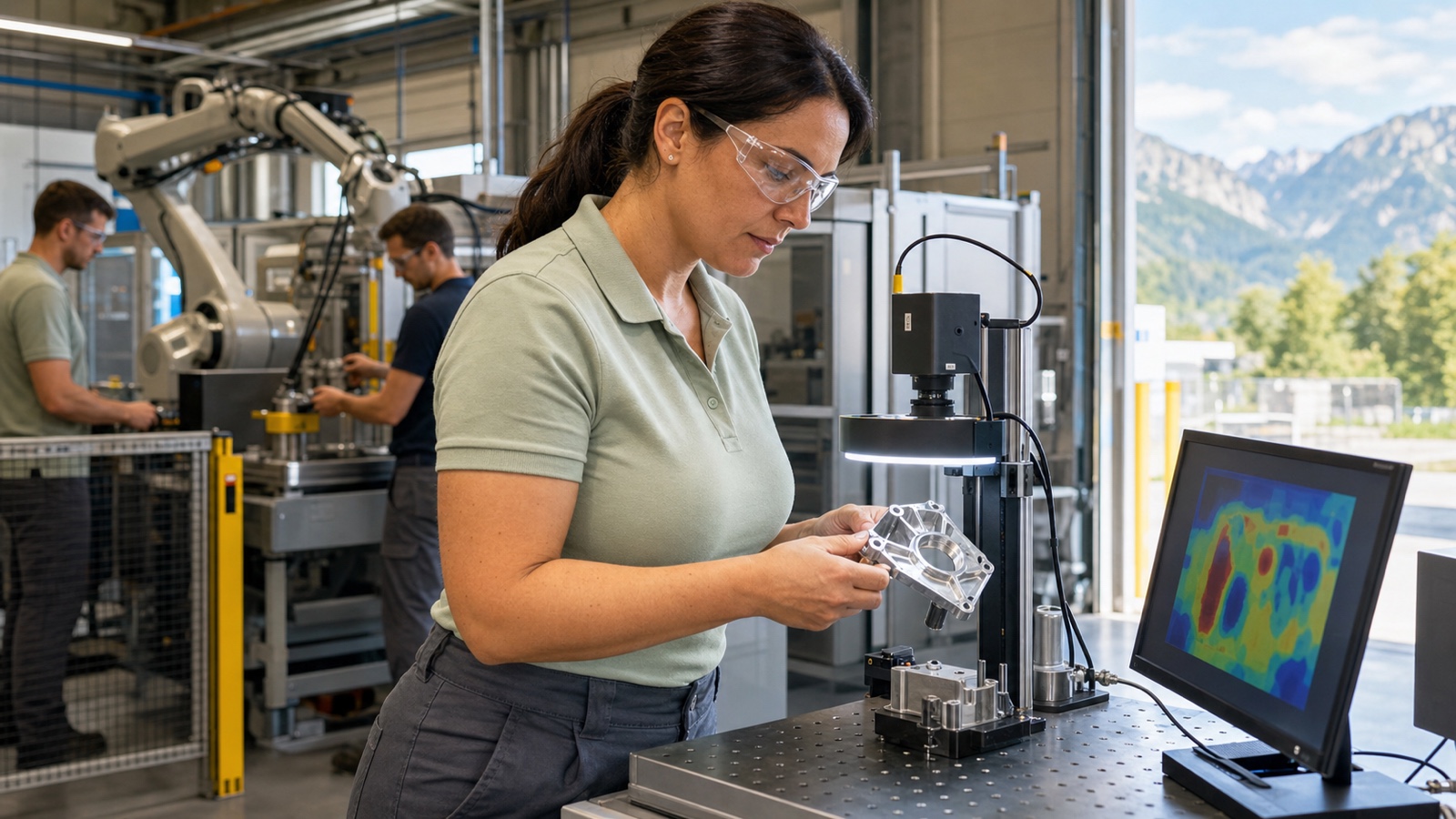
Artificial intelligence rarely enters production as a spectacular robot.Often it starts more inconspicuously: a camera flags possible surface defects, software detects unusual machine noises, or a planning system suggests a different sequence for orders. For employees in Austrian manufacturing companies, the question is therefore not only which tasks will be automated. What matters is who can technically review the systems' suggestions, recognize borderline cases and safely carry a process forward.
The change is already measurable. According to Statistics Austria around 30 percent of Austrian companies with ten or more employees used AI technologies in 2025. In the manufacturing sector it was 24 percent. Of the companies using AI, a quarter applied the technology in production or service processes. This does not mean that every workshop is already AI-controlled. But it shows that quality control, maintenance, planning and documentation are gradually changing in many companies.
What 'AI in production' actually means
In conversations, AI, automation and robotics are often conflated. For one’s own career planning, a clear separation helps:
- Classical automation executes predetermined steps. For example, a conveyor belt stops when a sensor detects a part.
- Robotics describes machines that take on physical tasks. A robot arm welds, lifts or positions components.
- AI analyzes data, detects patterns and provides predictions or classifications. It can, for example, flag unusual product images or calculate the likely maintenance needs of a system.
In practice these building blocks work together. A camera supplies images, an AI model evaluates them, a system sorts out suspicious parts, and a professional decides whether the finding is correct. It is precisely at this interface that experiential knowledge becomes valuable: the system recognizes statistical patterns but does not automatically know every material change, every makeshift repair, or every peculiarity of a customer order.
Six application areas that change work tasks
1. Visual quality inspection
Camera systems can detect scratches, deformations, color deviations or incomplete assembly steps. The WKO Oberösterreich points to a central difficulty in industrial anomaly detection: real defects are often very rare, borderline cases are complex, and experts' assessments are not always consistent. That is why a hit rate from a test lab does not replace a reliable inspection under changing light, with dust, vibrations and new product variants.
For employees the task shifts from purely manual checking to monitoring the entire inspection process. What is needed is clear labeling of defect types, plausibility checks, documentation and the ability to report false positives as well as missed findings. Those familiar with the material and process can explain why the model suddenly raises an alarm for a new finish.
2. Condition monitoring and predictive maintenance
Temperature, current draw, pressure, vibrations or noises provide clues about the condition of a machine. AI can make deviations visible earlier and announce a potential failure. This is not a crystal ball: a warning is initially a work order for inspection. Maintenance technicians must assess whether wear is actually present, a sensor is measuring incorrectly, or an allowable process change caused the signal.
This increases the importance of combining mechanics, electrical engineering and data literacy. Anyone who only reads the diagnostic value remains dependent on the system. Whoever combines measurements with noise, smell, running behavior and maintenance history can make a well-founded decision.
3. Production planning and sequencing of orders
Planning systems take material availability, setup times, delivery dates, personnel and machine capacities into account. AI can compute a proposal from many possible variants. Still, someone must recognize whether the data basis is complete. Is a short-notice sick leave missing? Is a tool actually available? May an order not start at all because of a quality release?
The role of production planning thus becomes more demanding. It requires process knowledge, prioritization and the ability to transparently correct a proposal. 'The system planned it that way' is not a tenable justification when safety, quality or realistic workloads argue otherwise.
4. Digital work instructions and assistance
Assistance systems can display work steps, find relevant documents or support troubleshooting. This is especially helpful with a high variety of variants, rare orders and onboarding. Good systems make knowledge more accessible; poor systems create extra clicks and distract from the workpiece.
Experienced employees do not become redundant here. They become important translators between the real process and the digital instruction. They recognize missing steps, formulate understandable notes and prevent an outdated standard from becoming a new source of errors.
5. Energy and material use
AI can make patterns of scrap, idle times or unusually high energy consumption visible. Economic benefit only arises, however, when teams understand the causes and test measures. Lower energy consumption is not progress if it causes drying times to be too short or tolerances to be violated.
Employees with process knowledge can translate data into concrete questions: Which batch was affected? Did the deviation occur after a tool change? Is the comparison between day and night shift fair? This kind of root-cause analysis becomes more important in data-rich companies.
6. Documentation and knowledge preservation
Generative AI can structure shift notes, prepare maintenance reports or search through extensive manuals. However, it can also add incorrect details or oversimplify relationships. Technical documentation therefore needs professional approval. Whoever confirms a report must be able to check the measurement value, component, time and action.
Especially for safety- or quality-relevant procedures it should be clear which data are used, which version is valid and who bears responsibility. Good documentation does not become less important just because a first draft is produced faster.
Which tasks remain clearly human?
AI can prepare a decision, but it does not automatically take responsibility for everyday production. Tasks that combine multiple types of knowledge remain particularly stable:
- assess unusual noises, smells, surfaces or running patterns in context;
- safely stop a machine in unclear or dangerous situations;
- weigh up quality, delivery pressure, ergonomics and occupational safety;
- practically set up new product variants, materials or special orders;
- narrow down causes of faults together with production, quality and maintenance;
- brief colleagues clearly and pass on informal experiential knowledge;
- apply customer requirements, standards and company-specific particularities to a concrete case.
An Austrian practical example shows what supplementation can look like: at a metal company in Upper Austria, an AI-supported camera inspects painted panels and marks possible defects. According to Chamber of Labour Upper Austria employees therefore have to lift and turn the panels less often. The technology reduces physical strain; the professional quality decision and the design of the workflow remain part of human work.
The competency profile for AI-supported manufacturing
Process understanding before prompt tricks
Those who understand cause and effect in the production process can better evaluate AI outputs. This includes material behavior, machine parameters, tolerances, setup sequences and typical fault patterns. This knowledge is often more important than the ability to write particularly elegant inputs for a language model.
Read data without becoming a data scientist
Employees should be able to interpret trends, thresholds and probabilities. What does a 70 percent warning mean? How many false alarms occurred last week? Was a model trained with comparable products? Such questions are more useful for many roles than programming skills.
Quality management and clean feedback
The AMS JobBarometer shows for production assistants that quality management knowledge featured among the most common requirements in Austrian job ads from 2022 to 2025. Compared between the periods 2022/23 and 2024/25, its importance also increased. Machine and plant operation as well as industry-specific material knowledge were also in greater demand. This fits AI practice: a model does not improve through vague criticism but through correctly recorded defects, traceable categories and consistent feedback.
Systematically narrow down faults
In case of a deviation, employees should not immediately blame the model or the machine. A sensible procedure first checks the sensor, material, parameters, tool, software version and environmental conditions. This structured troubleshooting saves time and prevents hasty action.
Communication across department boundaries
AI projects connect production, IT, quality, maintenance, data protection and often the works council. Those who can describe observations precisely become key figures. Instead of 'The AI doesn't work', it is more helpful to say, for example: 'Since switching to the matte surface, the camera at station three marks every second edge as a defect.'
Safety, data protection and human control
When systems evaluate not only machines but also the performance, pace or behavior of employees, additional risks arise. The EU-OSHA highlights the importance of participation and employee representation for preventing psychosocial risks in AI-supported work management. Employees should know which data are collected, what they are used for and when a human decision can override a system suggestion.
A learning plan in six steps
- Sketch your own process: Note incoming material, machines, inspections, handovers and typical disruptions. This makes visible where data arise and where decisions are made.
- Understand a specific AI system: Ask about purpose, input data, output and limits. Don't start with 'AI in general' but with the camera, prediction or assistance actually used in the company.
- Collect edge cases: Document material changes, rare defects, special orders and situations where experienced colleagues must deviate from the standard.
- Checking results: Compare the system message with real observation. Record false alarms, missed defects and correct detections separately.
- Deepen a complementary skill: Depending on your role, choose metrology, quality management, maintenance, data visualization, technical documentation or process planning.
- Test improvements in the team: Agree on a limited test with clear success criteria, feedback options and human approval. Only after that should a system be rolled out more widely.
Statistics Austria reports that 83 percent of companies using AI enable AI-related training for their employees. Most often this happens informally through self-study or colleagues. That's a good start, but for quality- or safety-critical applications it is not always sufficient. Documented briefings, exercises with real edge cases and a clear contact person are sensible. The jobspot.at guide on digital skills in the labor market.
Three roles that can be enhanced by AI
Production worker responsible for quality
They operate a machine, inspect parts and recognize typical defects. With a camera system, their role is not reduced to just confirming alerts. They become valuable when they classify defect types accurately, recognize new surface variants and provide feedback to quality and IT. Further training in metrology or quality management can support the next career step.
Maintenance technician between machine and data
They receive condition warnings, check sensor values and link them to maintenance history and real machine behavior. Particularly in demand is the ability to avoid unnecessary part replacements while still catching an impending failure in time. Basics in data visualization and Condition Monitoring complement mechanical or electrical skills.
Shift supervisor as translator
They have to bring together production targets, staffing, safety and system suggestions. Good shift supervisors explain why a suggestion was adjusted and document impacts on quality and workload. Leadership here also means not putting employees under pressure through constant KPI monitoring.
What applicants should check in job ads
Terms like 'Smart Factory', 'digital production' or 'AI-supported processes' say little about the actual workplace. In an interview, concrete questions help:
- Which AI application is already in productive use and which is only being tested?
- Who decides in case of conflicting results?
- What onboarding and further training are planned?
- Are employee data or individual performance metrics collected?
- How can errors and improvement suggestions be reported?
- What development opportunities are there in quality, maintenance or process planning?
Anyone wishing to change from another profession should not downplay existing experience. Precision, technical understanding, clean documentation and calm action during disruptions are transferable. The article 'Technology instead of the waiting loop' shows how to prepare for a career change into technical professions.
What companies can do better when implementing it
An AI project should not start with the purchase of software, but with a clear problem. What is the current error rate? Which physical strain should be reduced? Which downtimes should be detected earlier? Without a baseline, it is hard to judge later whether the system really helps.
The Austrian Initiative KI-Mobil names production, quality assurance, maintenance, knowledge management and administrative processes as typical industrial application areas. Crucial is a resource-efficient, practice-oriented entry. That argues for small tests with employees from the affected area rather than a blanket rollout planned at the drawing board.
Participation is not a brake either. The Arbeiterkammer Wien recommends involving the works council and employees early, explaining the system transparently and using feedback already in a test phase. This not only improves acceptance. Practitioners often spot early which data are missing, where an instruction is unclear and which metric generates unwanted pressure.
FAQ: AI and production jobs in Austria
Does AI replace production workers?
Some routine tasks can disappear or become less frequent. At the same time, tasks in inspection, data collection, fault analysis and process improvement emerge. How employment develops depends on the product, investment, organization and upskilling. A blanket job prognosis would be irresponsible.
Do I have to learn programming?
Not for many production roles. More important are process knowledge, quality understanding, structured troubleshooting and confident handling of digital displays. Programming is mainly relevant for specialized automation, data or development roles.
Which further training quickly brings benefits?
Choose training close to your current task: metrology for quality control, Condition Monitoring for maintenance, data visualization for planning or technical documentation for knowledge retention. A short course with practical application is often more valuable than a general AI certificate with no relation to the company.
What to do if an AI system is obviously wrong?
For safety or quality risks, follow the established company escalation path. Document input data, time, product variant and deviation as precisely as possible. A system error should not be quietly bypassed, as that loses important clues for correction and risk assessment.
Conclusion: Experience doesn't become less valuable, but valuable in different ways
AI in production mainly takes over the rapid recognition of patterns, sorting large amounts of data and calculating proposals. Employees remain decisive where context, responsibility and practical experience come together. Those who understand processes, recognize system limits and communicate results clearly gain importance.
The best next step is therefore small and concrete: choose a real workflow, identify the decision points and learn exactly the system that changes that workflow. That way 'AI competence' becomes not a buzzword but a demonstrable professional skill.
Sources
- Statistics Austria: Austria's companies among EU leaders in AI use, 24 June 2026
- Statistics Austria: ICT use in companies 2025
- AMS JobBarometer: Production assistant in Austria
- WKO/FMTI: KI-Mobil Austria
- Plattform Industrie 4.0: DOMINO – reliable EdgeAI for industrial applications
- EU-OSHA: Employee participation in AI-supported work management