The situation on the labor market is not the same in every sector. The AMS Upper Austria reported at the beginning of July 2026 that unemployment among women has recently risen particularly in office, retail, tourism, and health sectors. At the same time, the production and technology sector is developing more favorably. This regional snapshot cannot be applied across the board to all of Austria. However, it shows why a career change can be more than just a last resort.
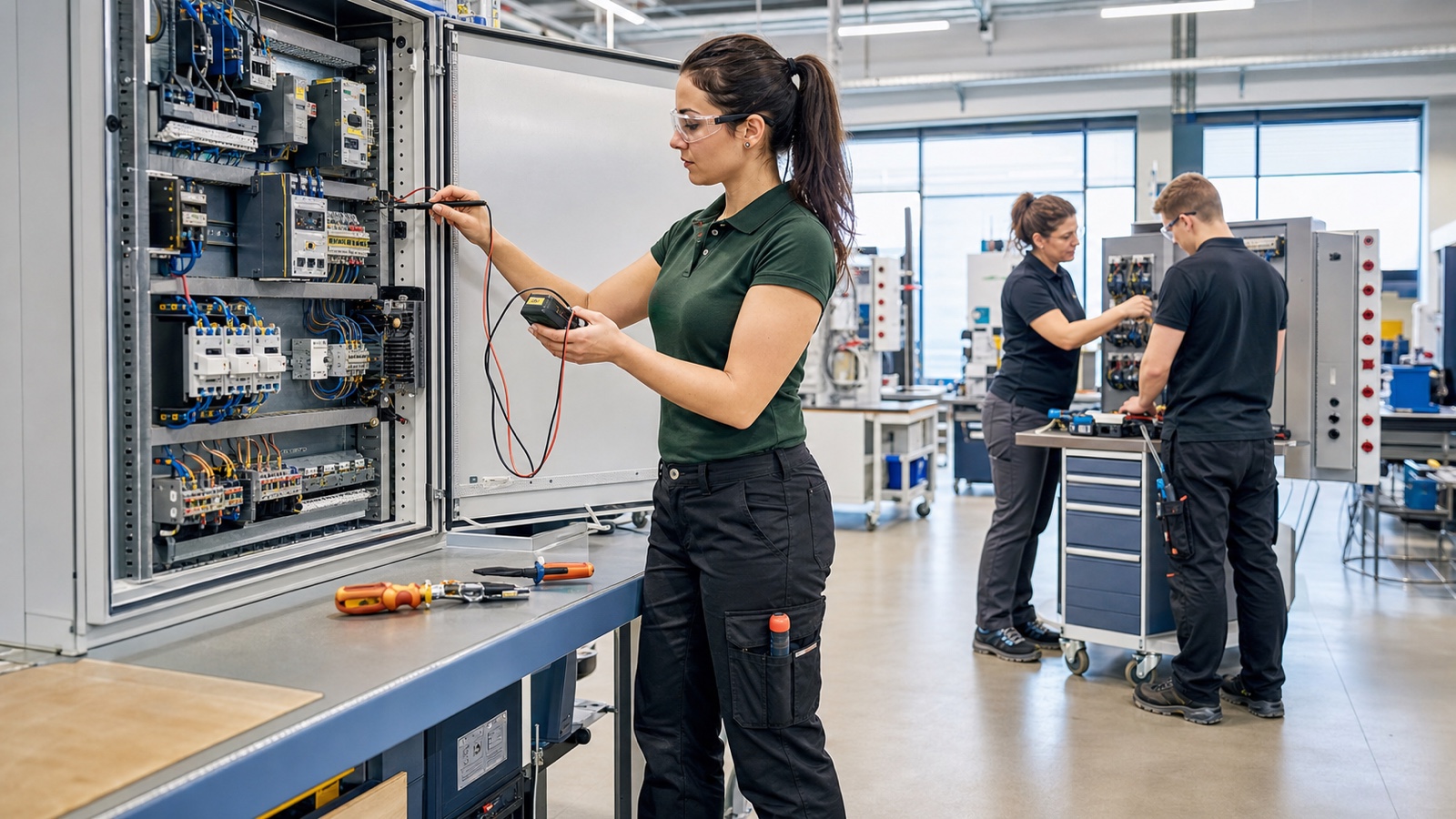
Technical jobs for women in Austria today go far beyond the workbench and construction site. Specialists are sought in areas including electrical engineering, building services engineering, mechatronics, automation, technical planning, quality assurance, and renewable energy. Many activities combine practical work with digital control, documentation, customer contact, or project organization.
This guide helps to soberly examine the professional field: Which activities match your own strengths? What training is required? What can the AMS FiT program achieve? And how does interest turn into a resilient application plan?
Why a look at technical professions makes sense
A career change should not be based solely on a buzzword like skilled labor shortage. The decisive factor is whether there is actual demand in the desired profession and in the accessible region. The AMS JobBarometer shows a generally positive three-year trend for 2026 to 2028 for electricians in installation and building services engineering. For 2025, the system recorded 19,628 job advertisements in this professional subgroup.
The number is not a promise for a personal job. However, it shows that there is a large and regionally distributed field of work. A particularly large number of advertisements came from Upper Austria, Styria, Lower Austria, and Vienna. Anyone thinking about a change should therefore check not only the job title but also the federal state, commuting radius, and specific companies.
Technical jobs can also serve long-term developments: energy transition, building renovation, automation, digital production control, and modern supply networks. An overview of related activities is also provided by the jobspot guide on Green Jobs in Austria.
Technology is broader than many job titles suggest
Anyone who has previously worked in retail, the office, catering, or the health sector does not have to know immediately whether electrical engineering, mechatronics, or technical drawing is a better fit. First, the preferred type of work should be clarified.
- Practical and mobile: assembling systems, troubleshooting, maintaining devices, or taking on customer appointments.
- Precise and stationary: operating machines, checking quality, documenting measured values, or manufacturing components.
- Planning and digital: creating technical drawings, preparing processes, scheduling materials, or coordinating projects.
- Communicative and technical: processing service cases, explaining products, coordinating teams, or training customers.
This distinction is more helpful than the question of whether someone is a "tech type." Many skills from other sectors are transferable: careful work, safety awareness, spatial thinking, customer contact, shift organization, documentation, and calm handling of disruptions.
What the AMS FiT program offers
FiT stands for "Women in Craft and Technology." The Austria-wide AMS program is aimed at women who are registered as unemployed or job-seeking with the AMS. According to the AMS, participation is possible regardless of previous education and qualification level. More than 200 training courses in manual and technical areas are funded.
The program can include several stages: vocational orientation, practical testing, necessary pre-qualification, and training with an apprenticeship, school, college, or university of applied sciences degree. This can be supplemented by counseling, learning support, and assistance for reconciling training and family. Depending on the case, course costs, incidental course costs, training allowances, or childcare allowances are also relevant.
The details differ regionally. Furthermore, there is no automatic legal entitlement to AMS funding. Interested parties should therefore not book a fee-based training course before the goal, eligibility, and application have been clarified with the responsible AMS advisor. The AMS generally recommends applying for educational funding before the start of the course.
An evaluation by the AMS Lower Austria shows how concrete the support can be: In the 2025/2026 training year, 1,140 FiT places were available there. According to the AMS, 78 percent of participants who completed FiT training were employed three months later. This is a regional program result and not an Austria-wide guarantee of success, but a useful reference point.
The self-check before technical training
A good funding opportunity does not replace the examination of everyday professional life. Before starting a longer training course, applicants should research at least one realistic working day. The following questions help with this:
- Do I prefer to work in changing locations or at a fixed workplace?
- How do I feel about shift work, on-call duty, early start times, or field assignments?
- What physical requirements, protective clothing, and safety rules are part of the job?
- How much mathematics, digital documentation, or technical English is actually needed?
- Can I reliably reach the training location and future companies?
- What care obligations or fixed financial costs must be covered during the training?
An internship, trial day, or conversation with a specialist usually provides better answers than a job video alone. It is important not only to look at the most interesting activity. Cleaning, documentation, material transport, troubleshooting, and safety checks are also part of everyday life.
In four steps from interest to career plan
1. Choose a concrete goal instead of "something with technology"
Start with two or three fields of activity. Compare tasks, training duration, working hours, and regional positions. The AMS JobBarometer, the career compass, and current job advertisements show which skills employers actually mention. Pay attention to whether a driver's license, shift readiness, CAD, electrical engineering basics, or certain certificates are regularly required.
2. Test practice before the training is set
Use orientation courses, company visits, and internships. Observe whether the environment, the pace of work, and the type of problem-solving suit you. Ask employees not only about the advantages but also about stressful phases, learning effort, and typical mistakes made by career starters.
3. Plan training and financing together
Clarify the degree, duration, admission requirements, and costs. In addition to FiT, other AMS instruments may be relevant depending on the starting situation. The article on the Skilled Worker Scholarship explains another possibility for training in high-demand professions. Funding paths should not be combined or assumed without having the individual eligibility confirmed.
4. Seek a company connection early
Do not wait until the last day of training. Research companies, internship positions, and entry-level roles early on. A brief contact can clarify which modules count particularly and whether a company offers internships, precise qualification, or an entry after graduation.
How to turn your previous resume into an advantage
Career changers should not hide their previous experience. The key is the translation into the new profession. A salesperson can contribute customer communication, merchandise management, and complaint resolution. An office employee knows documentation, scheduling, and digital systems. An employee from catering or nursing brings resilience, hygiene and safety awareness, and coordinated teamwork.
In the resume, these skills should be supported with concrete situations. Add technical courses, practical hours, tools used, safety instructions, and projects. Small results from training or internships can serve as work samples. The jobspot article Work samples show explains how such evidence can be presented in an understandable way.
In the cover letter, general enthusiasm for technology is not enough. More convincing is a clear development: Why was exactly this professional field chosen? What has already been tested practically? Which degree is being achieved? Which transferable skills shorten the training period?
What should be clarified in the job interview
A technical entry is not just a question of the job title. Applicants should also check the conditions of the specific workplace:
- How is the training organized and who accompanies new specialists?
- Which shifts, field services, or on-call duties are planned?
- Which protective clothing is provided and are there suitable sizes?
- Which collective agreement and classification is paid?
- Which further training or additional qualifications are possible after entry?
- How are changing rooms, sanitary facilities, and workplaces organized in the company?
These questions are not special requests. They show that the applicant takes everyday work seriously. At the same time, the answers reveal whether a company is prepared for career changers or is merely speaking generally about the shortage of skilled workers.
A technical restart is not a question of age
The AMS Lower Austria reports that nine percent of FiT participants in 2025 belonged to the 50-plus generation. A late change is therefore fundamentally part of program practice. However, training duration, health requirements, insurance periods, and regional demand should be checked particularly carefully.
Experience can be valuable in a technical environment if it is translated concretely: reliable work organization, customer contact, quality awareness, and confident handling of responsibility. Additional information is provided by the guide on Jobs for people over 50.
Conclusion: Test first, then qualify
Technical jobs for women in Austria offer real opportunities, but no automatic shortcut to a secure job. Good decisions combine three levels: personal suitability, demonstrable regional demand, and affordable training with a recognized degree.
The most sensible next step is small and concrete: Choose two technical activities, check current positions in your commuting radius, and then arrange a consultation at the AMS or FiT center. Anyone who tests everyday work before training and plans the company connection early turns a vague interest into a resilient career path.