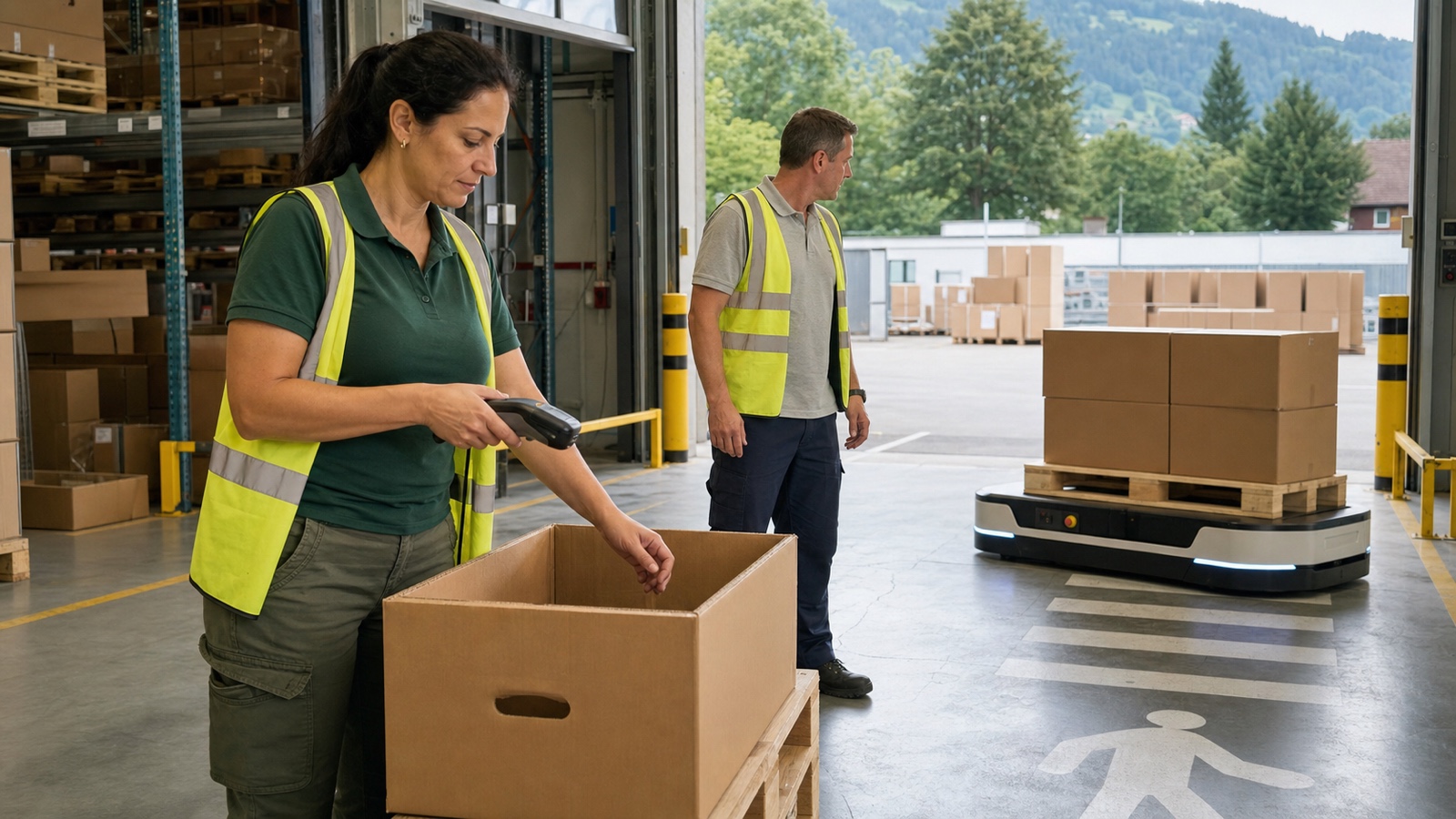
Automatically optimizing routes, predicting inventory, detecting delivery delays, and managing goods in the warehouse: AI in logistics sounds like largely automated processes. In practice, the gap between a pilot project and a reliable daily work routine is still large. According to Statistics Austria, 30 percent of Austrian companies with ten or more employees were already using AI in 2025. However, of the companies using AI, only 5 percent used it in the logistics sector.
This is precisely why now is a good time to take a sober look at the change. AI replaces neither supply chain knowledge nor experience with disruptions, safety rules, and customer expectations. However, it does shift tasks: employees must evaluate suggestions faster, detect data errors, decide on exceptions, and document automated processes in an understandable way. This guide shows what this means for warehousing, dispatch, freight forwarding, and logistics management in Austria.
AI in logistics: the most important points at a glance
| Work area | What AI can support | What humans must decide |
|---|---|---|
| Dispatch | Suggesting routes, capacity utilization, and time windows | Evaluating feasibility, priorities, driver feedback, and disruptions |
| Inventory planning | Forecasting demand and bottlenecks from historical data | Classifying special effects, promotions, supplier risks, and data gaps |
| Warehouse | Optimizing paths, sequences, and replenishment | Clarifying safety, damaged goods, unclear locations, and exceptions |
| Documents | Pre-structuring delivery notes, orders, and status messages | Checking content, correcting deviations, and granting approvals |
| Quality | Marking anomalies in images, quantities, or process data | Determining the cause of errors and reacting appropriately |
| Control | Bundling key figures and prioritizing risks | Weighing goals, taking responsibility, and coordinating teams |
The current development is not a purely future scenario. In its Innovation Map 2026, the WKO describes applications ranging from demand forecasting and warehouse control to transport planning and the last mile. A WKO specialist event on AI in transport and logistics in September 2026 focuses explicitly on already stable practical applications and typical implementation errors.
Why logistics jobs remain in demand despite automation
The AMS JobBarometer shows 30,657 online job advertisements for the warehouse and logistics occupational group in 2025. For skilled workers in this area, the trend for 2026 to 2028 is assessed as tending to be positive. Particularly frequently sought are, among others, professional drivers, logistics managers, logisticians, and operational logistics clerks.
The picture is more differentiated for semi-skilled and auxiliary jobs. The AMS points out that semi-automated warehouse management, digital inventory management, and robot-assisted picking are taking over standardized routines. While demand remains high, the three-year trend in this group is assessed negatively. This distinction is important for employees: automation affects tasks to varying degrees, not an entire industry in the same way.
Those who only perform individual repeatable steps are more likely to be affected by a redistribution of work. Those who understand processes, resolve deviations, operate technology safely, and communicate with other areas, on the other hand, are gaining in importance. This is not a promise that every position will remain unchanged. However, it shows why further training in logistics can be particularly effective.
Seven applications that are changing everyday work
1. Demand and inventory forecasts
AI can combine sales histories, seasonal patterns, delivery times, and external influencing factors. This results in suggestions for order quantities or safety stocks. However, a forecast is not an order. Promotions, new products, supplier failures, or unusual events can make historical patterns unusable. Employees must recognize when the model is operating outside its usual range.
2. Route and tour planning
A system can combine shipments, vehicles, time windows, and distances. A field report from the WKO Lower Austria shows how a local logistics company uses AI for tour optimization. In everyday life, questions remain that data alone cannot solve: Is an access road actually usable? How realistic is the loading time? Which customer needs a telephone notification in advance? Which route makes sense in heat, construction sites, or driving time limits?
3. Control of warehouse paths
Software can plan picking sequences, trigger replenishment, or coordinate autonomous transport vehicles. The task of employees shifts from pure path execution to monitoring: blocked aisles, incorrectly parked pallets, damaged packaging, or missing scans must be recognized quickly. Physical work does not automatically disappear as a result, but it is more closely linked to digital systems.
4. Document processing
Order data, delivery notes, and emails can be read and pre-sorted. This saves data entry work, especially with different formats. Errors remain possible: a confused unit of measurement, an incomplete address, or an incorrectly assigned time window can disrupt the entire subsequent process. Anyone who approves therefore needs a clear verification framework instead of blind trust.
5. Detection of deviations
AI can mark unusual inventory movements, delayed shipments, or quality anomalies. Good systems reduce the number of cases that humans have to check. Poor thresholds, on the other hand, create floods of alarms. Skilled workers must judge which deviation is really critical and which only appears statistically unusual.
6. Maintenance and Physical AI
Sensors and models can provide indications of wear and tear before a conveyor belt or vehicle fails. The WKO describes the combination of AI, robotics, sensor technology, and autonomous systems as Physical AI and sees it as an important development step for industry, logistics, and mobility. In practice, safe shutdown, control, and professional maintenance remain human areas of responsibility.
7. Shift and performance management
Algorithms can distribute orders, calculate work cycles, or compare performance. This concerns not only efficiency but also working conditions. EU-OSHA points out that algorithmic management occurs particularly frequently in repetition-intensive areas such as warehousing, transport, and retail, and that psychosocial and physical risks must be taken into account. Employees should know what data is collected, how key figures are calculated, and who corrects incorrect assessments.
How specific job roles are changing
Warehouse and picking
Scanners, warehouse management, and automatic prioritization specify work steps more and more precisely. Knowledge of goods, quality control, safe movement in the warehouse, and dealing with disruptions remain in demand. Added to this is the ability to correctly interpret system messages: Is the storage space really empty or is just a scan missing? Is the route blocked or are master data incorrect? Good employees solve the cause instead of just acknowledging the message.
Dispatch and transport processing
Dispatch is becoming less of a manual puzzle task and more of a controlled decision about suggestions. This requires knowledge of capacity, time windows, legal limits, customer priorities, and regional specifics. Communication also remains central. If a tour is changed, drivers, customers, warehouses, and, if necessary, partner companies must understand the consequences.
Freight forwarding and clerical work
Standard inquiries and documents can be prepared faster. Customs, liability, hazardous goods, special transports, and contradictory information remain demanding. Skilled workers must check sources and recognize when an automated text sounds technically sound but does not fit the case in terms of content.
Logistics management
Managers do not have to program every model. But they must define goals and limits: Which key figure is being optimized? What is the system allowed to trigger automatically? What error rate is acceptable? How is work done in the event of a failure? Who makes the decision? Without these questions, AI may accelerate the wrong process.
These competencies are becoming more valuable in applications
The AMS JobBarometer for warehouse and logistics mentions not only driver's licenses and logistics knowledge but also transport processing, IT application, business software, and quality management. For AI-supported processes, six particularly useful competence fields can be derived from this:
- Process understanding: from order through warehousing and transport to delivery
- Data quality: Plausibility check of master data, scans, units of measurement, and status information
- Software practice: safely operating inventory management, transport management, scanners, and reporting
- Exception management: resolving bottlenecks, damages, delays, and contradictory suggestions
- Communication: translating decisions to drivers, warehouses, customers, and managers
- Safety awareness: never placing digital specifications above occupational safety and real danger situations
"I know AI" is too imprecise in an application. A concrete example is more meaningful: "I checked tour suggestions with capacity and time window data, documented deviations, and incorporated driver feedback into the planning." Anyone who does not yet have professional experience with AI can create a small work sample. The jobspot.at guide Work samples show explains how a comprehensible process is more convincing than a collection of buzzwords.
A secure verification process for AI suggestions
- Clarify goal: Should the system optimize time, costs, distance, inventory, or service quality?
- Check inputs: Are addresses, quantities, time windows, capacities, and restrictions up to date?
- Plausibility check of suggestion: Does the result fit process knowledge and the real situation?
- Control risks: Were safety, working time, customer requirements, and special cases taken into account?
- Document decision: What was adopted, changed, or rejected and why?
- Report back result: Did the planned improvement actually occur?
This process turns an AI output into a controlled work aid. It also prevents errors from continuing just because a system seems fast and confident.
Four practical cases from everyday logistics
Case 1: The shortest route does not fit the delivery
The software plans a narrow inner-city access in the morning. The driver knows that there is no suitable loading zone free there at this time. He reports the conflict, the dispatcher checks a later time window and documents the deviation. The added value lies not in blind obedience, but in the combination of model and experiential knowledge.
Case 2: A forecast overlooks a regional promotion
The system expects normal demand. However, a regional sales focus was not recorded in the data. The inventory planner increases the demand with justification and ensures that the promotion information is incorporated in a structured manner in the future. In this way, human control also improves the data basis.
Case 3: An automatic order endangers the safe process
A transport device is to enter an area that is blocked due to cleaning work. The employees stop the order and report the missing blocking information. Physical safety takes precedence over the cycle specification. The incident is not only solved locally but corrected as a process error.
Case 4: A delivery note is read incorrectly
The document recognition enters a number into the wrong quantity field. The clerk discovers the implausible deviation when comparing it with the order and packaging unit. Only then does he release the process. The decisive factor was not fast typing, but professional plausibility control.
What employees should ask before an AI introduction
- What concrete problem should the system solve?
- What data does it use and how up-to-date is it?
- Which decisions does it make automatically and which only as a suggestion?
- How can employees stop or override an incorrect specification?
- Who controls errors, failures, and unwanted side effects?
- Is individual performance, movement, or behavior evaluated?
- What training is planned for the respective role?
- How does feedback from the warehouse, dispatch, and driving service flow back?
Since February 2025, the AI Act has required appropriate AI competence for personnel working with AI systems. The AI Service Center of the RTR emphasizes that training must match technical knowledge, the context of use, and the persons affected. A general lecture therefore does not replace instruction in the logistics system actually used. A structured learning plan is offered by the jobspot.at article AI competence becomes a job factor.
A 30-day learning plan for logistics professionals
Week 1: Make the process visible
Choose a process, such as incoming goods, picking, or tour planning. Note inputs, decisions, handovers, and typical errors. Without a process image, the benefit of an AI system can hardly be assessed.
Week 2: Understand data and key figures
Check which master data and status values control the process. Learn two to three key figures so well that you can explain their limits. High capacity utilization, for example, is not automatically good if time windows or safety suffer as a result.
Week 3: Test suggestions critically
Compare a system suggestion with a professional solution using anonymized examples. Document deviations and reasons. Do not use confidential customer or employee data in freely accessible AI services.
Week 4: Formulate result as a work sample
Describe the initial situation, test criteria, decision, and result on one page. This shows process understanding, digital competence, and responsible control. This combination is stronger for applications than an unsubstantiated reference to "AI experience".
Frequently asked questions about AI in logistics
Does AI replace warehouse workers?
Individual routines can be automated, especially with standardized movements and recordings. At the same time, control, exceptions, safety, quality, and flexible cooperation remain necessary. The AMS expects stronger pressure for change for auxiliary jobs, while skilled workers in warehousing and logistics remain in high demand.
Do logistics employees need to be able to program?
Not for most operational roles. More important are process knowledge, safe handling of specialist software, data understanding, and the ability to recognize incorrect suggestions. Technical deepening can make sense for key users, process management, or system support.
Is every automatic route suggestion already AI?
No. Many systems work with fixed rules or classic optimization. For employees, the product name is less important than the functionality: What data is processed, how is the suggestion created, where are the limits, and who decides?
What belongs in an application?
Name a concrete tool or process and describe your contribution. Examples are master data checking, tour plausibility checking, scanner practice, warehouse management, deviation analysis, or feedback to dispatch. Stick to verifiable experience.
What role does the works council play?
If systems process employee data, control performance, or evaluate behavior, data protection, labor law, and co-determination can be affected. Employees should ask early about the purpose, data use, and correction options and, if necessary, involve the works council, trade union, or chamber of labor.
Conclusion: Logistics know-how is not reduced by AI, but becomes more verifiable
AI in logistics primarily takes over pattern recognition, forecasts, and optimization suggestions. Good work begins afterwards: checking data, recognizing real limits, ensuring safety, resolving exceptions, and communicating decisions. Those who combine these skills with digital practice position themselves significantly better for warehousing, dispatch, freight forwarding, and logistics management.
The next sensible step is small: Choose a recurring process from your everyday work and write down what information a good decision needs. That is exactly where it becomes clear which task can be automated and where your experience remains indispensable.
Sources and further information
- Statistics Austria: Austria's companies among the EU leaders in the use of AI, June 24, 2026
- Statistics Austria: ICT use in companies 2025
- AMS JobBarometer: Warehouse and logistics in Austria
- AMS JobBarometer: Semi-skilled and auxiliary jobs in logistics and transport
- WKO Lower Austria: AI optimizes truck routes
- EU-OSHA: AI-based and algorithmic work management