Artificial intelligence doesn't drive itself across the field and it doesn't independently decide what a farm plants.However, it can analyze image, sensor, weather, and machine data, produce forecasts, and make anomalous developments visible earlier. In doing so, it changes tasks in farming, agricultural engineering, and advisory services. People who combine digital outputs with field experience become especially valuable.
For Austria this is more than a future scenario. Current research projects are testing explainable AI for crop production and irrigation, a professorship for data-driven AI in agriculture is being established in Wieselburg, and a free online course teaches Precision Farming. This guide shows where AI in agricultureis already applied in practice, which professions benefit from it, and how professionals can build a robust competency profile.
Why AI is a skilled-labor issue for Austrian farms
Agricultural decisions depend on many factors: soil, variety, weather, pest pressure, water availability, machinery, costs and legal requirements. Digital systems increase the amount of available information. However, they do not automatically resolve the question of which information is actually relevant for action on a specific farm.
The Federal Ministry for Agriculture and Forestry describes Digitalization and Precision Farming as an opportunity for a more efficient and more ecological use of inputs. With the Innovation Farm at the locations Wieselburg, Raumberg-Gumpenstein and Mold, there is an Austrian testing and knowledge-transfer structure for this. The free APOS correction service also supports highly precise satellite-based positioning.
Such infrastructure only becomes useful through qualified application. A farm needs people who deploy sensors correctly, check datasets, evaluate models from a technical perspective and operate machinery safely. In advisory and technical roles translation tasks are added: What does a model value mean for the next step, and when is an on-site check more important than the digital recommendation?
Distinguishing precision farming, automation and AI
The terms are often conflated. For job applications and continuing education, a clear distinction is worthwhile:
- digitalization makes information available electronically, such as field parcel records, machine data, or weather records.
- Precision Farming bewirtschaftet Flächen räumlich und zeitlich genauer, beispielsweise mit GNSS, Teilbreitenschaltung oder Applikationskarten.
- Automation führt definierte Abläufe nach Regeln aus, etwa eine Lenkung entlang einer geplanten Spur.
- AI erkennt Muster in Daten, klassifiziert Bilder, schätzt Zustände oder erstellt Prognosen und Empfehlungen.
In der Praxis greifen diese Ebenen ineinander. Eine KI-basierte Erkennung von Unkraut ist wertlos, wenn die Kamera verschmutzt ist, die Pflanzen im Trainingsdatensatz anders aussehen oder die Maschine die Information nicht zuverlässig umsetzt. Agronomisches Wissen, saubere Daten und funktionierende Technik bleiben daher Teil derselben Arbeitskette.
Fünf Anwendungen, die Aufgaben auf Acker und Hof verändern
1. Pflanzen und Unkraut auf Bildern erkennen
Kameras auf Maschinen, mobilen Geräten oder stationären Systemen liefern große Mengen an Bilddaten. KI kann Pflanzenarten unterscheiden, Entwicklungsstadien einschätzen oder verdächtige Stellen markieren. Dadurch lassen sich Kontrollen gezielter planen und Betriebsmittel möglicherweise genauer einsetzen.
Das österreichische FFG-Projekt "CultivateAnything läuft von 2026 bis 2029. It explores hybrid AI for customizable, explainable and certifiable applications in precision agriculture. One focus is on new, rare or invasive species for which only limited training data are available. This highlights the central challenge: a model must be able to handle unknown situations without feigning certainty.
2. Better estimate the right timing for measures
Sowing, irrigation, fertilization, crop protection and harvest are time-critical. AI can combine weather data, plant observations and development models to narrow time windows. The decision nevertheless remains farm-specific, because field passability, labor availability, machinery capacity and local experience must be taken into account.
This is exactly what the FFG project PhenAI in the years 2026 and 2027. A hybrid plant model is intended to predict phenological development stages and thereby support the scheduling of agricultural operations. For staff this will not be a mere operator task: they must understand input data and forecast quality and document deviations.
3. Predict soil moisture, yield and irrigation
Satellite imagery, weather data, soil data and local measurements can together provide a more accurate situational picture. The FFG project AISAAC develops explainable AI for yield, soil moisture and irrigation. The project period runs from 2025 to 2027.
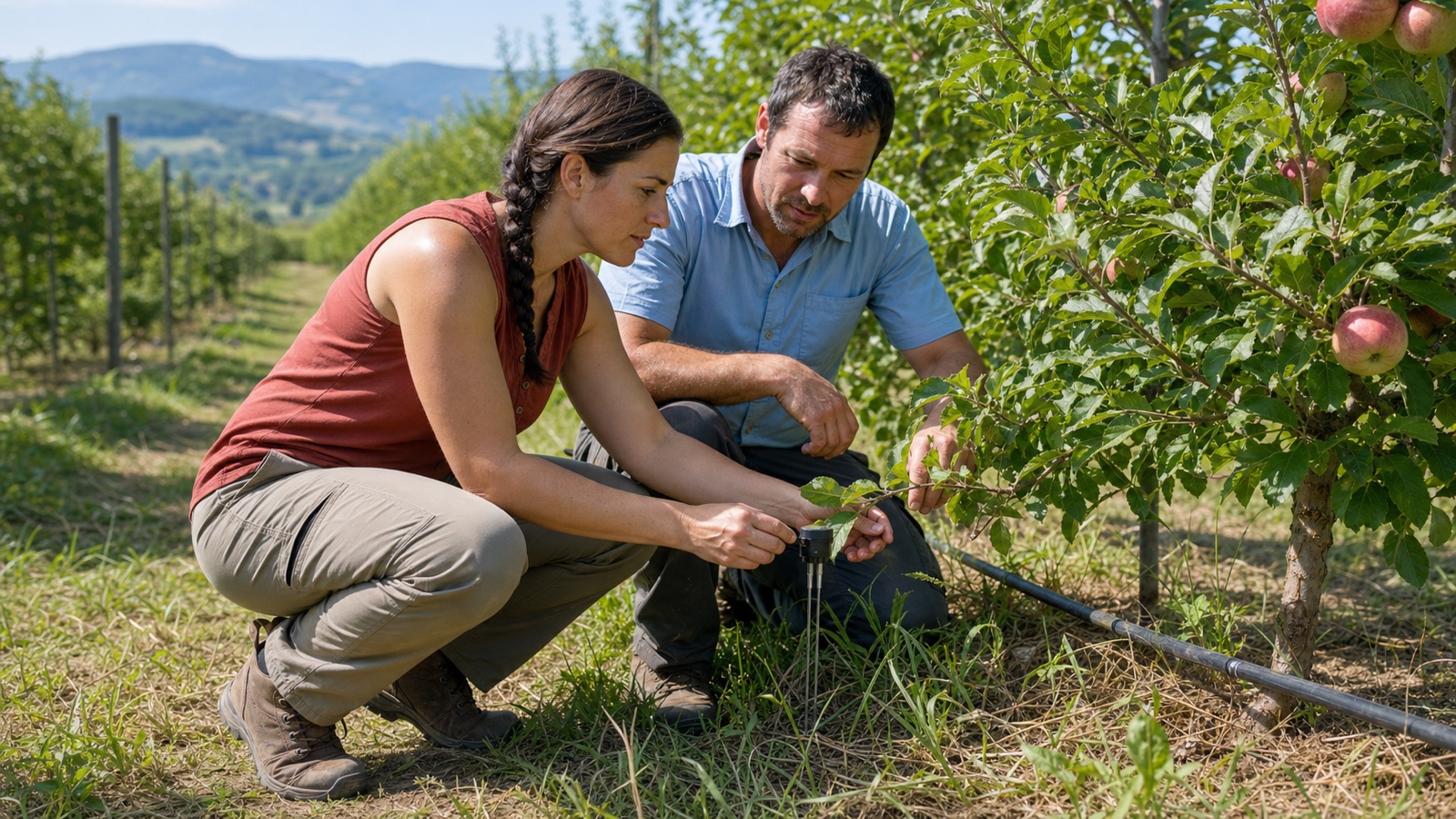
The benefit is not a single number on the screen. What matters is whether specialists can tell when a sensor fails, when cloud cover affects satellite data, or when a model represents an area too coarsely. Only then can it be assessed whether an irrigation round should be postponed, a subarea inspected, or an assumption corrected.
4. Apply inputs site-specifically
Application maps and sensor values can help machines apply seed, fertilizer or crop protection products in a spatially differentiated way. On the Innovation Farm im Projektbereich Ackerbau, among other things, tillage, sowing, fertilization, crop protection, data management and satellite monitoring are covered.
Those who manage such systems need multiple perspectives at once. The agronomic question is which measure is agronomically appropriate. The technical question concerns calibration, interfaces, and machine settings. The economic question determines whether the effort and benefit fit the operation. AI can reveal patterns, but it cannot replace these three checks.
5. Plan maintenance and technical support more strategically
Agricultural machines generate operational, fault, and sensor data. Models can prioritize anomalies and provide clues for troubleshooting. However, a warning signal is not a diagnosis. Technicians must check whether wear, operation, software, sensors, electrics, or operating conditions are the cause.
This increases the importance of roles at the interface between the workshop, the field, and digital support. People who understand mechanics and electronics and can also interpret data translate an automatic message into a safe repair or deployment decision.
Tasks that explicitly remain with humans
Assess local conditions
A model only knows the information available to it. Compacted wheel tracks, small-scale soil variations, wildlife damage, a clogged nozzle, or a sudden weather change can alter the result. Field inspection and experience remain indispensable.
Ensure data quality
Misplaced sensors, inaccurate field boundaries, missing calibration, or inconsistent labels lead to poor results. Good data work therefore does not begin with complicated models, but with traceable collection, plausibility checks, and documentation.
Take responsibility for safety
A recommendation must not override machine or occupational safety rules. Whoever operates, maintains, or authorizes equipment needs clear responsibilities. If results are uncertain, it must be clear when a system should be stopped, a specialist consulted, or a proven procedure followed.
Make economic decisions
Not every technically feasible application is cost-effective for every farm. Purchase, subscription, data connectivity, training, maintenance, and additional documentation effort should be factored into the calculation. Equally important is whether data can be exported and what happens when switching providers.
Five professional profiles with good prospects
Farmer (female), farmer (male), or farm management
The core competence remains production. Added to this are the selection, implementation, and oversight of digital tools. A particularly convincing profile is one that can solve a concrete operational problem, for example documenting water use, comparing inventories, or reducing machine operating time.
Female agricultural advisor or crop advisor
Consulting translates data into professional options. This requires knowledge of varieties, soil, and crops, as well as the ability to explain model limitations in an understandable way. Consultants should not only present recommendations but also make assumptions and uncertainties visible.
Agricultural and construction machinery technician
Mechanics, hydraulics, electronics, sensor technology, and software are merging. The AMS JobBarometer shows 2,738 online job advertisements for agricultural and construction machinery technology in 2025 and assesses the trend for 2026 to 2028 as generally positive. A particularly high number of advertisements were counted in Lower Austria with 653 and in Upper Austria with 645, followed by Styria with 354.
These figures do not prove that AI alone creates additional jobs. However, they do show a relevant Austrian labor market for technical roles that digital diagnostics, sensor technology, and precision farming connect well to. Anyone planning to enter the field will find further guidance in the overview of technical jobs and training paths.
Agronomic data or GIS specialist
This profile combines geospatial data, remote sensing, statistics, and agriculture. Tasks range from area analyses and data cleaning to the evaluation of model results. A computer science degree can help, but it does not replace an understanding of crop production and farm operations.
Product consulting, sales and training
Manufacturers and service providers need people who deploy systems, train customers, and relay feedback to development teams. Those who can explain functions in concrete work steps and openly address limitations are seen as credible.
Eight competencies employers can practically assess
- Agronomic basics:Understand soil, plant development, inputs and equipment, and typical work processes.
- Sensing and positioning:Assess measurement principles, GNSS, RTK, calibration, and potential sources of error.
- Data quality:Identify missing values, outliers, unit errors, and implausible results.
- Check AI results: Confidence, reference values, and operational limits instead of looking at just one output.
- Use geospatial data: Interpret map layers, area boundaries, satellite imagery, and spatial variations.
- Consider machine safety: Translate digital suggestions into safe, approved work steps.
- Clarify data rights: Check export, access, storage, and vendor lock-in before deployment.
- Communicate clearly: Explain technical findings clearly for farm management, workshop staff, and advisors.
No one has to master all eight areas at an expert level. For an application, a T-profile makes sense: solid basic knowledge across the entire workflow and demonstrable depth in one specialty, for example agricultural engineering, crop production, GIS, or data analysis.
Build a presentable learning project in 30 days
Week 1: Define an operational question
Choose a narrow task, for example: How can soil moisture data be validated for plausibility? What information does site-specific fertilization require? How is a machine warning checked in a structured way? Note the goal, available data, safety limits, and success criterion.
Week 2: Learn the fundamentals in a focused way
The Francisco Josephinum presented in July 2026 a "free online course on Precision Farming is planned. Five micro-credentials of roughly 25 hours each cover fundamentals, arable farming, data processing and AI, viticulture, and robotics. Those who complete all units can obtain the qualification 'Precision Farming Specialist'.
First choose the unit that fits the learning project. Document not only completed lessons but also three insights, two open questions, and one possible application.
Week 3: Check data and results
Work with a small, legally available dataset or with self-collected measurements. Check units, timestamps, missing values, and outliers. Then create a simple analysis or decision matrix. The important point is not to train your own AI model, but to evaluate the quality of a digital recommendation in a way that is understandable and reproducible.
Week 4: Create a work sample and reflection
Summarize the initial question, data basis, verification steps, result, uncertainties, and next action on two pages. Add screenshots or a simple graphic only if no confidential farm data are visible. This work sample demonstrates to employers more than the general claim that you are interested in AI.
Three practical case studies for job applications and professional development
Irrigation in orchards or vineyards
Connect soil moisture, weather forecast and plant observations. Describe at what measurement error you would check a sensor and which decision should never be based solely on a model value.
Weed detection in arable farming
Compare digital classification with an on-site sample. Record which plants are confused, how light and growth stage affect the result, and when an automatic recommendation must be blocked.
Digital diagnostics in agricultural machinery
Develop a diagnostic workflow from an error message through visual inspection and measurement to the repair decision. Show which information comes from the system and which qualifications are required for the intervention.
How to credibly demonstrate AI competence in a job application
A good application doesn't list a long toolset without context. It connects task, approach and outcome. A suitable resume bullet could read: "Checked soil moisture and weather data for three fields, documented faulty sensor values, and cross-checked irrigation decisions with field inspections."
Concrete answers to four questions are helpful in the conversation:
- Which operational problem should be solved?
- How were the data and the result checked for plausibility?
- Which decision was consciously left to a specialist?
- What would you improve in the next run?
Those seeking a sustainable career can also combine such digital skills with opportunities in Green Jobs in Austriaconnect. Agricultural knowledge, resource efficiency and technology are a particularly robust combination.
What farms should clarify before implementation
Before purchasing or running a pilot, those responsible should not only compare features. They need a clear deployment process:
- Who is functionally responsible for the output, and who is responsible for the technical functionality?
- What data is collected, where is it stored, and how is it exported?
- How is performance tested under Austrian operating conditions?
- What happens in the event of a dead zone, sensor failure, or implausible result?
- What training is required for operators, consultants, workshop staff, and management?
- How are wrong decisions, corrections, and learning experiences documented?
The Austrian AI Service Center of the RTR emphasizes in AI competence according to the AI Act, that technical, legal, and ethical knowledge must match the role and the context of use. A general introductory lecture is therefore not sufficient for all tasks. For a structured implementation, the in-depth jobspot guide on AI competence in everyday professional life.
Training also builds capacity. In May 2026, the Francisco Josephinum reported on a new Professorship for data-driven AI in agriculture, together with FH Wiener Neustadt and with around €1.5 million in funding. The appointment was scheduled for 2026. This strengthens the connection between research, teaching and agricultural practice in Wieselburg.
FAQ on AI in agriculture
Do I need a computer science degree for an AI job in agriculture?
No. For many roles, agronomic, technical or advisory knowledge is the starting point. What matters is being able to check digital results and translate them into safe work steps. For development and advanced data analysis, in-depth computer science or statistics knowledge is useful.
What further training is suitable for getting started?
Start with precision farming basics and a small practical project. The free course from Francisco Josephinum provides up-to-date Austrian content for this. Depending on the target role, add sensor technology, GIS, farm machinery, crop production, or data analysis.
Does AI replace agricultural experience?
No. Models can provide patterns and forecasts, but they cannot fully represent local conditions, machine safety, economic viability, and responsibility. Experience becomes especially important where digital outputs must be checked and justifiably corrected.
What questions should I ask a technology provider?
Ask about data sources, regional testing, known failure cases, export options, support, updates, costs, and behavior during outages. Ask them to explain how uncertainty is displayed and which decisions must be confirmed by an expert.
Conclusion: agricultural expertise becomes more valuable through digital judgement
AI in agriculture is not a single profession and not an autonomous solution. It is an additional layer of tools between field observation, sensors, machinery, and operational decision-making. Austrian research, education, and practical offerings show that this field of work is already concretely growing.
The best opportunities go to professionals who not only operate technology but also check results, identify limits, and plausibly justify actions. A small documented learning project is the most sensible next step: choose a real question, verify the data, derive a decision, and record where human experience remains indispensable.