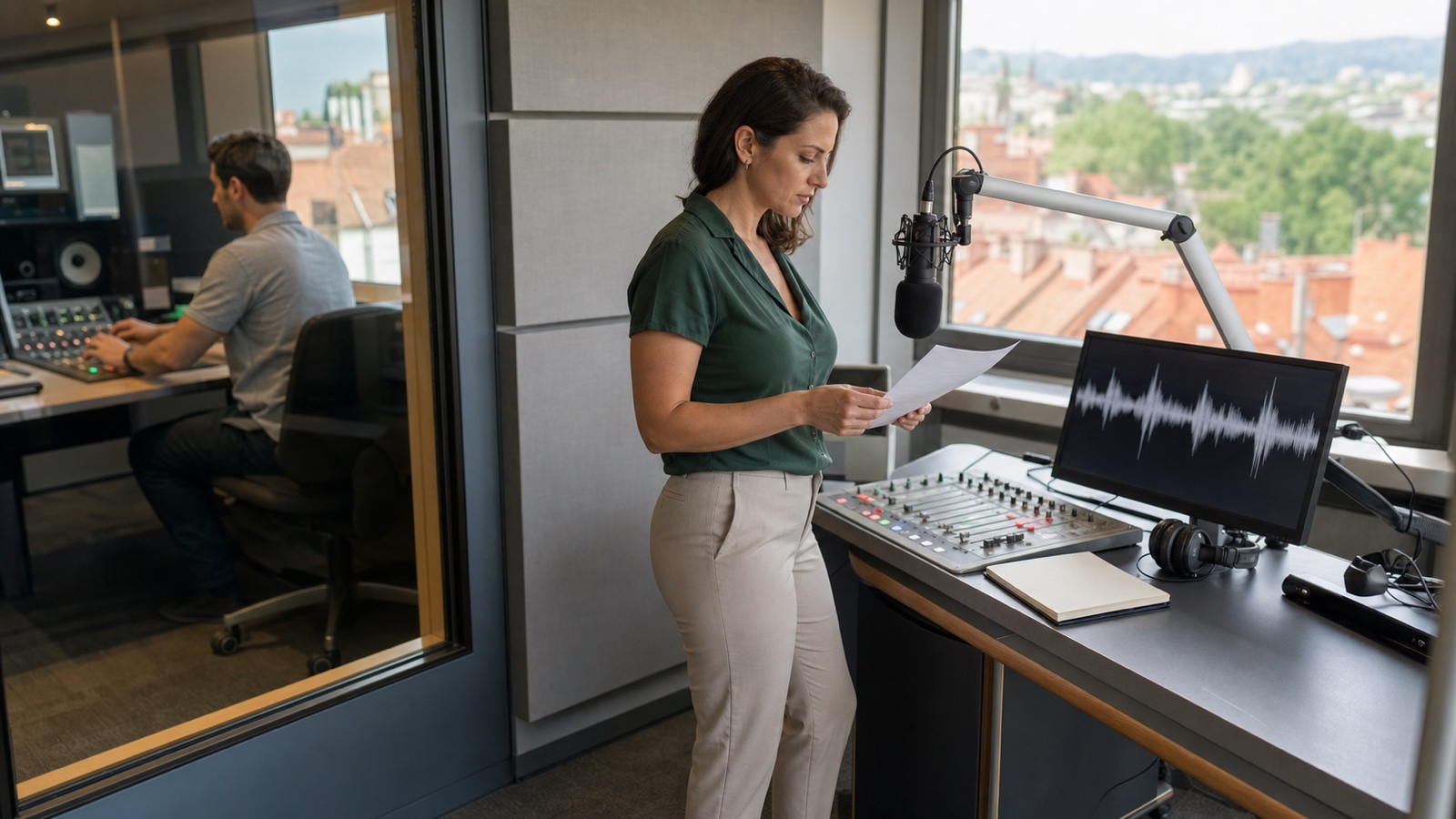
AI can transcribe interviews, pre-sort large volumes of documents, search data for patterns, and prepare content for various distribution channels. However, it can also confuse names, invent sources, smooth out quotes, and show photorealistic events that never took place. For journalists, therefore, there is no shortcut that bypasses editorial responsibility. The key new skill is to use AI sensibly and to verify every relevant result in a traceable manner.
Furthermore, the transparency obligations of Article 50 of the European AI Act have been in effect since August 2, 2026. For Austrian media professions, AI in journalism is therefore not just a question of efficient tools. It is about source criticism, labeling, data protection, rights, documentation, and clear final responsibility. This guide explains which tasks can be supported, where the specific risks lie, and what a practical editorial workflow looks like.
The most important points in brief
- AI remains a tool: The editorial team is responsible for research, selection, classification, and publication.
- Text is a special case: For texts about matters of public interest, the disclosure obligation may be waived if a genuine human review or editorial oversight takes place and a person or organization assumes editorial responsibility.
- Deepfakes require disclosure: Realistic-seeming AI images, audio, or videos can be considered deepfakes, even if no real person was copied.
- Distinguish two roles: Providers of generative systems must technically and machine-readably label synthetic outputs; media companies as operators may face additional visible disclosure obligations.
- Standard processing is not automatically a deepfake: Minor color correction, noise reduction, or similar optimizations typically do not materially change authenticity.
- Verification will become a core competency:Sources, figures, quotes, names, rights, distortions, and labeling must be addressed before any publication.
The article provides professional guidance and not individual legal advice. In unclear borderline cases, the editorial team, legal department, data protection officers, or external consultants should be involved.
What has changed since August 2, 2026
Article 50 of the AI Act regulates transparency obligations for certain AI systems and content. The AI Service Center of the RTR distinguishes between, among other things, direct AI interaction, synthetic content, deepfakes, and AI-generated texts used to inform the public about matters of public interest.
For editorial teams, it is important not to lump all obligations together. The provider of a generative system must generally equip its outputs with a technical, machine-readable label. Anyone using the system professionally and publishing content, on the other hand, is typically an operator. For operators, the focus is primarily on understandable disclosures for deepfakes and certain text publications.
The EU Commission explains in its current guidelines that Article 50 has been applicable since August 2, 2026. For systems that were already on the market before that date, a transitional rule may apply to technical provider labeling until December 2, 2026. However, this is not a general postponement for every editorial disclosure. Editorial teams should therefore document the system, content, time of publication, and their own role separately.
The editorial text exception is not a free pass
An AI-generated or substantially manipulated text on a matter of public interest must generally be disclosed as such. According to the RTR interpretation, the obligation is waived if the content has been subjected to human review or editorial control and a natural or legal person assumes editorial responsibility.
In practice, that does not mean a quick glance at a finished AI text is sufficient. A robust editorial review must address the relevant statements: Are sources and facts correct? Are quotes reproduced as in the original? Have uncertainties been made visible? Is the selection fair and professionally justifiable? Is the publication consistent with duties of care, media law, and internal guidelines?
Anyone who cannot answer these questions should not publish the text or should clearly disclose the use of AI and re-examine the piece. A name in the author field does not replace a documented editorial process.
Deepfakes: Why even invented people are relevant
The AI Act understands deepfakes as image, audio, or video content that appears realistic, resembles real people, places, objects, institutions, or events, and can falsely be perceived as real. According to the current RTR interpretation, a photorealistic person without a real-life model can also fall under this definition if the audience might consider the depiction authentic.
This is particularly sensitive for news and informational content. A generated stock photo can be misinterpreted as documentation of a real event. A synthetic voice can create the impression of a real interview. A manipulated video can attribute words or actions to a person that never occurred.
The disclosure must be clear, unambiguous, and provided at first perception. For images and videos, a visible label is appropriate; for audio-only content, an audible notice is appropriate. Alt text and technical metadata can supplement, but do not automatically replace information that is immediately perceptible. Artistic, satirical, or fictional formats may use eased forms of disclosure; purely informational pieces should not prematurely invoke this exception.
Which editorial tasks AI can usefully support
Transcription and indexing
AI can make long interviews, press conferences, or meetings searchable. The transcription is a working document, not a citable source. Names, figures, technical terms, and any published quote must be checked against the audio, video, or original record.
Sort and summarize documents
For reports, laws, or studies, AI can highlight topic sections and potential contradictions. Good newsrooms make the source and context available for every claim and read the decisive passages in the original. A summary must not replace the primary source.
Explore data
Language models can suggest analysis ideas, formulas, or code. Numbers still require plausibility checks, reproducible calculations, and documented filters. Spot checks are not enough when a metric carries the core claim of the piece.
Formats and accessibility
A verified article can be prepared for newsletters, audio introductions, social media, or easy-to-understand summaries. The adaptation must be checked again for shifts in meaning, incorrect shortening, and appropriate context. Captions and alt texts also benefit from assistance, but require human final review.
Ideas and research questions
AI can provide counter-questions, possible perspectives, or search terms. It is an idea generator, not a source. What matters is which aspects the editorial team chooses, which people it interviews, and which evidence it publishes.
Where editorial teams need to be especially cautious
- Live and breaking news:Time pressure increases the risk of unverified errors and incorrect attributions.
- Politics and elections:Synthetic statements, images, or videos can manipulate public debate.
- Health, justice, and security: imprecise wording can cause concrete harm to people.
- Victims, accused and minors: Protection of identity and privacy requires particularly restrained processing.
- Confidential documents: Unpublished documents, contact details and internal information should not be placed into external systems without review.
- Synthetic voices and faces: Consent, rights and the potential for deception must be clarified before production and publication.
- Automated publishing: No system should publish journalistic content live without defined human approval.
The ORF AI guidelines verankern das Human-in-the-Loop-Prinzip und belassen redaktionelle Hoheit sowie Letztverantwortung bei den Mitarbeiterinnen und Mitarbeitern. Die APA AI guideline stellt menschliche Autonomie, Schadensverhütung, Fairness, Erklärbarkeit und journalistische Qualitätsstandards in den Mittelpunkt. Beide Beispiele zeigen: Ein Tool wird nicht allein danach bewertet, was technisch möglich ist, sondern ob ein klarer Anwendungsfall verantwortbar ist.
The eight-step workflow before publication
- Define the task: Legen Sie fest, ob KI transkribiert, sortiert, analysiert, formuliert oder Bild und Ton erzeugt. Ein enger Zweck ist besser prüfbar als „Mach daraus einen fertigen Artikel“.
- Tool und Daten prüfen: Verwenden Sie freigegebene Systeme. Klären Sie, welche Daten eingegeben werden dürfen und ob vertrauliche oder personenbezogene Informationen betroffen sind.
- Secure original sources: Speichern Sie Dokumente, Audio, Links und Datensätze, gegen die das Ergebnis kontrolliert wird.
- Verify facts and quotes: Kontrollieren Sie Namen, Funktionen, Daten, Zahlen, Zitate und kausale Aussagen direkt an den Originalen.
- Auswahl und Verzerrung prüfen: Fragen Sie, welche Perspektiven fehlen, welche Gruppen stereotyp dargestellt werden und ob die Gewichtung journalistisch begründet ist.
- Rechte und Schäden bewerten: Prüfen Sie Persönlichkeitsrechte, Datenschutz, Urheber- und Nutzungsrechte sowie mögliche Folgen einer falschen Veröffentlichung.
- Decide on disclosure: Dokumentieren Sie, ob ein Deepfake, ein Text zu öffentlichem Interesse oder nur unterstützende Standardbearbeitung vorliegt. Wählen Sie eine klare, barrierearme Kennzeichnung.
- Verantwortlich freigeben: Eine benannte Person bestätigt Inhalt, Methode und Veröffentlichung. Bei heiklen Fällen gilt das Vier-Augen-Prinzip.
Ein solcher Ablauf macht die Redaktion nicht langsamer, wenn Vorlagen, Rollen und Eskalationswege vorbereitet sind. Er verhindert, dass jedes Team bei einem Grenzfall wieder bei null beginnt.
Welche Kompetenzen in Medienjobs wichtiger werden
Quellenkritik und Verifikation
People who review AI outputs must be able to find primary sources, compare original material, and assess uncertainty. Traditional investigative/research skills therefore become more important.
Understanding of methods and data
Members of the editorial team do not need to program every model. They should, however, be able to recognise when an answer merely sounds plausible, how a dataset was generated, and which control steps make an analysis reproducible.
Law and editorial ethics
The AI Act, data protection, personality rights, copyright, and internal media guidelines interact. We are looking for people who identify legal issues early rather than escalating them only after publication.
Transparent communication
Good labelling briefly explains to the audience what was artificially generated or substantially altered. It must neither be hidden nor give the impression that every spell-check amounts to a contribution to the AI article.
Editorial decision-making authority
Which story is relevant, which sources are credible and which presentation is fair remains a journalistic decision. It is precisely this judgment that distinguishes responsible media work from automated content production.
Anyone who wants to systematically build the foundations will find in the jobspot.at-Learning plan for AI skills on the job an introduction and in the article about digital skills in the Austrian labor market a broader contextualization.
What the AMS data mean for applicants
The AMS JobBarometer for female and male journalists weist für 2025 nur 62 ausgewertete Onlineinserate und für 2026 bis 2028 einen negativen Trend aus. Diese Zahl bildet nicht den gesamten Medienarbeitsmarkt ab: freie Mitarbeit, persönliche Netzwerke, interne Besetzungen und angrenzende Kommunikationsrollen können in öffentlichen Inseraten fehlen. Sie zeigt dennoch, dass Bewerbungen ein klares fachliches Profil brauchen.
"Ich kann ChatGPT" ist kein solches Profil. Aussagekräftiger sind konkrete Arbeitsproben:
- an interview with verified transcription and documented quote verification,
- a data analysis with sources, calculation steps, and error checking,
- an article with a transparent labeling decision,
- research where AI only provided search directions and primary sources carry the content,
- a short editorial risk analysis for a synthetic image, audio, or video.
The guide to Work samples in job applications shows how results are presented with the initial situation, personal contribution, and verifiable outcome.
A 30-day learning project for media professionals
Week 1: Check transcription
Transcribe a ten-minute, self-recorded conversation. Mark every error in names, numbers, dialect, and sentence boundaries. From that, create a personal checklist.
Week 2: Source-based summary
Choose an official report. Have possible key statements and open questions suggested, link each statement to a source reference, and remove anything the original does not support.
Week 3: Evaluate synthetic material
Take a fictitious image or audio concept. Check for potential deception, rights, disclosure, alt text, and the journalistic necessity. You do not need to produce the material for this.
Week 4: Document workflow
Create a one-page template with task, tool, input data, sources, controls, labeling decision and approval. Test the template on a short, non-critical news item.
Three typical editorial cases
Case 1: Interview transcription
An editor uses AI to transcribe an interview. She listens to all quoted passages in the original, checks names and context, and writes the piece herself. The benefit lies in making the material accessible; source and responsibility remain clear.
Case 2: Photorealistic illustrative image
A local newsroom generates a realistically appearing accident scene because no real image is available. The audience could mistake it for a photograph of the event. The newsroom must clarify deepfake and labeling issues and should consider whether a neutral graphic or a clearly recognizable illustrative image is more journalistically responsible.
Case 3: Fully automated news item
A system creates a text from a press release and publishes it without human oversight. For a topic of public interest, editorial review is missing; the text exception does not simply apply. Additionally, error, source and liability risks remain unresolved. The workflow requires a human sign-off before publishing.
FAQ on AI in journalism
Must every AI-assisted article be labeled?
No — not every assistive use automatically requires a visible label. Key factors are the type of system, the significance of the change, the content, editorial control, and responsibility. Internal policies may go beyond the legal minimum.
Is editorial oversight sufficient for AI-generated images?
The text exception must not be applied to images, audio, and video. If the material constitutes a deepfake, disclosure is generally still required.
May AI improve the wording of quotes?
Journalistic quotes must accurately reflect the statement. Any smoothing should be checked against the original and the editorial citation rules. AI must not attribute a more concise formulation to someone that they did not actually say.
Which tools should be included in an application?
Name only tools that you actually master. More important than the product list is what task you solve with them, how you protect data, and how you verify results.
Does AI replace journalistic training?
No. Research, media law, ethics, dramaturgy, interview technique, and editorial decision‑making remain fundamental. AI competence complements these skills.
Conclusion: Credibility is established in the verification process
AI in journalism can reduce routine work and open up new research opportunities. Its professional value, however, only becomes apparent when newsrooms properly organize assignments, data, sources, controls, and disclosure. Especially for public issues, photorealistic images, voices, and videos, technical skill alone is not enough.
For media professionals, therefore, a combination will be decisive: journalistic diligence, AI competence, legal awareness, and transparent communication. Those who demonstrate these skills with verifiable work samples show not only familiarity with tools, but the judgment that credible media will continue to need.
Sources and further information
- RTR AI service point: Transparency obligations under Article 50 of the AI Act
- European Commission: Guidelines on transparency obligations, updated on 29 July 2026
- ORF: AI Guidelines and Human-in-the-Loop Principle
- APA: Guideline on the Use of Artificial Intelligence
- AMS JobBarometer: Journalist in Austria
- RTR: 2026 Guidelines for the Promotion of Quality Journalism