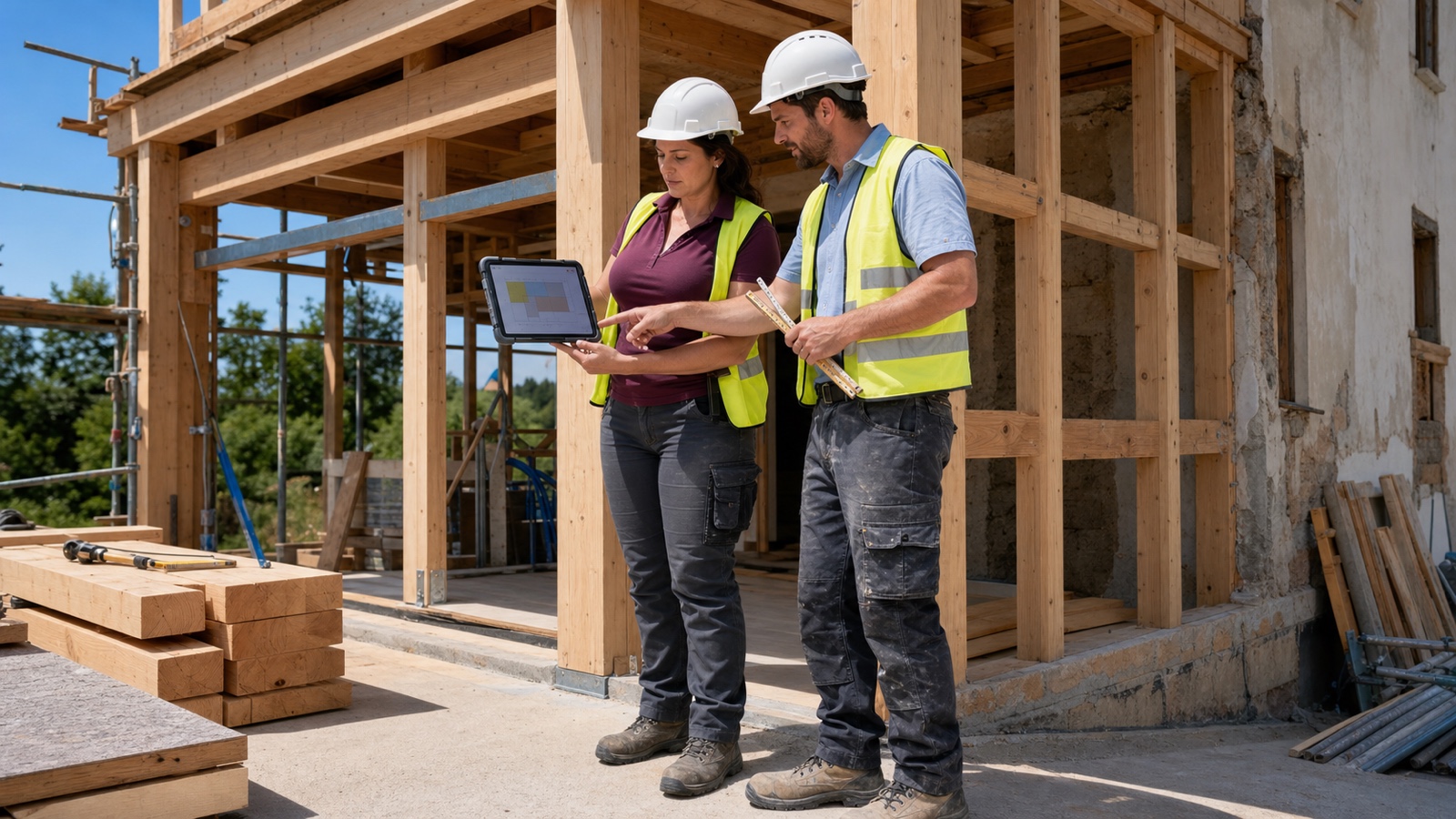
Artificial intelligence does not arrive on Austrian construction sites first as a humanoid robot. It is more likely to be found in documentation aids, schedule forecasts, plan reviews, or applications that pre-sort photos and measured values. This changes work, but it does not replace construction engineering experience or the responsibility for safe execution.
For employees, the crucial question is therefore not whether AI will "take over construction." More important is: What suggestions can a system provide, who checks them on the actual construction site, and which skills become more valuable as a result? This guide classifies AI in the construction industry in Austria from the perspective of specialists, site management, foremen, building services engineering, and applicants.
Why the topic is relevant for Austria's labor market
The construction industry is simultaneously under pressure regarding costs, deadlines, and skilled labor. The AMS JobBarometer shows 38,881 online job advertisements in 2025 for the occupational group of construction technology, structural engineering, and civil engineering. Site managers, construction technicians, and construction foremen are particularly sought after. Despite economic fluctuations, the demand for qualified specialists remains high.
At the same time, thermal renovations, sustainable building materials, the circular economy, and digital planning and construction processes are changing the requirement profile. According to the AMS, project management, IT application, quality management, communication, and systematic working are gaining importance. AI reinforces this development: it processes data faster, but can only be used reliably with usable source data and expert control.
What is actually meant by AI in construction
In everyday construction site life, several technologies are easily mixed up. A digital building model is not automatically AI. A rule-based calculation, a laser scanner, or a remote-controlled machine is not a learning system in itself.
Distinguishing between BIM, automation, and AI
- BIM structures information about a building in a digital model.
- Automation executes pre-defined processes according to fixed rules.
- AI recognizes patterns, generates content, or provides forecasts and recommendations based on data.
- Robotics connects digital control with a physical machine; AI can, but does not have to be, part of it.
In practice, these areas overlap. For example, an application can combine data from a BIM model, site diaries, and current photos to suggest discrepancies. Whether there is actually a defect, a plan status problem, or just a different perspective must be clarified by a knowledgeable person.
Six applications that are changing everyday construction site life
The WKO summary of a basic study on AI use in the construction industry mentions, among other things, progress monitoring, material management, and schedule forecasts. The current WKO focus on installation and building services engineering also shows how AI can support documentation and onboarding. This results in six particularly tangible fields of application.
1. Documentation from speech, photos, and notes
A specialist records observations, assigns photos to a component, and adds measured values. AI can use this to create a structured draft for a site diary, defect list, or handover protocol. The WKO aptly summarizes the benefit as less paperwork and more time on the construction site.
However, the draft is not yet an approved document. Names, dates, plan status, components, measured values, and responsibilities must be checked. In the event of a later dispute, comprehensible documentation counts, not the linguistic elegance of an automatically generated text.
2. Plan and document search
On larger projects, many plans, protocols, product data sheets, and addenda are created. An AI-supported search can find relevant passages faster or highlight differences between versions. This saves search time if documents are cleanly named, versioned, and approved.
It becomes dangerous if a system prefers an outdated plan or provides an answer without a clear source reference. Employees therefore need access to the original document and must check the plan status and approval themselves.
3. Schedule and process forecasts
Systems can derive possible delays from past projects, delivery dates, weather information, and current progress. This can support site management and foremen in preparation. However, a note like "Trade B is expected to start two days later" is not an automatically valid rescheduling.
On-site, dependencies that may be missing from the data count: a blocked access road, an outstanding approval, missing personnel, safety requirements, or a last-minute change by the client. The forecast opens up a conversation; it does not replace coordination.
4. Quality and discrepancy detection
Image and sensor data can help to pre-select visible discrepancies, damage, or implausible measured values. This is particularly useful when many similar components are being checked. The specialist then decides whether a discrepancy is relevant, what its cause is, and what measures are necessary.
Furthermore, a photo never shows the whole situation. Hidden areas, material properties, light, perspective, and construction status can influence the result. An AI marking must therefore not be confused with a technical acceptance.
5. Quantities, material, and logistics
AI can analyze consumption patterns, suggest order quantities, or point out possible bottlenecks. This can relieve storage areas and reduce unnecessary transport. However, good suggestions require correct quantities, units, delivery deadlines, material qualities, and current plan statuses.
Especially with alternative products, expert knowledge remains central. Approvals, tenders, fire, sound, and thermal insulation, as well as releases, must not be replaced by a mere similarity recommendation.
6. Circular economy and existing buildings
The Austrian BMIMI flagship project KRAISBAU is developing AI tools for circular construction from 2024 to 2028. 32 construction companies, research institutions, architectural firms, and other institutions are involved. Among other things, the existing building stock, material exploration, recycled building materials, and material flows are being investigated.
For employees, this creates tasks at the interface of the construction site, data, and materials science: correctly recording components, assessing material qualities, identifying data gaps, and comparing digital information with the actual stock. Anyone interested in sustainable construction projects can also find information in the jobspot.at guide about Green Jobs in Austria.
Which tasks remain explicitly human
The more suggestions a system provides, the more important a clear final decision becomes. On a construction site, digital assumptions meet changing weather, improvised interfaces, real people, and safety-critical situations.
Comparing reality with the data status
Specialists recognize whether a plan fits the executed situation, whether a component is accessible, and whether a recommendation can be implemented in practice. They also notice when a seemingly small discrepancy affects subsequent work.
Coordinating trades and people
Site management and foremen resolve goal conflicts: schedule vs. quality, faster workflow vs. safe access, or material requests vs. technical admissibility. This requires communication, negotiation, and experience with the trades involved.
Assessing safety and approving measures
The Labor inspectorate for coordination during construction work describes specific responsibilities of the client, project management, and planning and construction site coordination. If there are several employers on a construction site, protective measures must be coordinated. An AI hint can support this, but does not transfer this responsibility to the software.
An application must therefore neither "approve" fall protection nor independently decide whether work can continue under changed conditions. Safety decisions require qualified persons, current on-site perception, and documented responsibilities.
How specific job roles are changing
Site management and construction technology
Less time can be spent on searching, sorting, and initial report drafts. More time is needed for plausibility checks, interfaces, approvals, and escalation. Those who understand data sources and clearly document decisions gain value.
Foreman and supervisor
Digital suggestions must be translated into realistic work sequences. The foreman recognizes whether the team, material, equipment, and safe access actually fit together. Experience is not devalued by this, but becomes a control instance for digital planning.
Installation and building services engineering
The WKO focus on AI in installation and building services engineering shows applications for small and medium-sized enterprises, such as documentation aids or structured onboarding. For fitters, this can reduce rework in the office. At the same time, technical specifications, customer data, and system documents must remain protected.
Skilled workers
For masons, carpenters, plumbers, electricians, or surveying technicians, not every core activity shifts. What is new is primarily structured feedback: What was actually executed? What discrepancy occurred? What data is missing? Good digital recording makes practical knowledge usable for the project.
Seven skills that are now becoming more important
- Technical plausibility check: Compare a result with standards, plan status, material, and execution.
- Data quality: Completely record units, designations, photos, times, and responsibilities.
- Source control: Be able to find the underlying document or measured value for every answer.
- Error communication: Mark uncertainties instead of silently adopting an AI suggestion.
- Data protection and confidentiality: Only use personal, customer, and project data in approved systems.
- Interface understanding: Know how the model, schedule, documentation, and construction site reality are connected.
- Coordination: Translate digital hints into clear, safe agreements between trades.
The RTR guide on Article 4 of the AI Act emphasizes that AI competence must match experience, training, and the context of use. A general one-hour webinar is therefore not enough for every role. A site manager needs different controls than an apprentice, a cost estimator, or a fitter.
A structured learning plan is described in the jobspot.at article AI competence becomes a job factor. For construction, it should be supplemented with real plans, approved test data, and concrete error scenarios.
Four red lines for safe use
Do not upload confidential plans to public tools
Floor plans, construction site photos, names, contact details, and contract documents can contain personal data or trade secrets. Employees should only use approved applications, defined accounts, and clarified storage locations.
No automatic approval of safety-critical measures
AI may mark risks or prepare checklists. The assessment of scaffolding, fall protection, excavation pits, traffic routes, or work procedures remains with the qualified and responsible persons.
No evaluation of employees through hidden key figures
Surveillance can easily arise from photo, location, or performance data. Purpose, access, storage duration, and evaluation must be clarified transparently. Employees and the works council should be involved early on before individual performance profiles are created from process data.
No changes without a traceable plan status
A plausibly sounding suggestion is not an order. Changes belong in the intended approval process and must be documented with source, version, responsibility, and time.
A realistic 30-day learning plan for employees
Week 1: Understand a process
Choose a frequent, low-risk task, such as structuring notes. Document which input data is used and where errors occur. Use only tools approved by the company.
Week 2: Define test criteria
Create five control questions: Is the plan status current? Do the unit and component match? Is the source visible? Are boundary conditions missing? Who is allowed to approve? Compare AI drafts with manually created examples.
Week 3: Test a practical case in the team
Test the process with site management, foremen, or the responsible specialist. Collect not only time savings but also correction effort, error types, and open data protection questions.
Week 4: Document results and limits
Record what the tool may be used for, which data is excluded, and which person takes over the final check. Only then should a broader introduction be decided.
Three practical cases: This is what good control looks like
Case 1: The site diary is fast but inaccurate
An application creates a readable report from voice notes but assigns a delivery to the wrong component. The site manager compares the draft with the delivery note and photo time, corrects the error, and adds a mandatory selection for the component. Benefit is created not by blind adoption, but by a better process.
Case 2: The schedule forecast overlooks an approval
The system suggests scheduling a subsequent trade earlier. The foreman recognizes that a technical approval is still missing and that access would therefore be unsafe. He stops the rescheduling, clarifies the approval, and documents the missing dependency for future forecasts.
Case 3: Photo analysis marks a supposed defect
An image check marks an area as a discrepancy. The skilled worker checks the plan, perspective, and executed detail. It is an approved variant. The marking is closed with a source instead of entering the statistics as an automatic defect.
How to show AI competence in your application
Do not just write "AI skills" in your CV. More meaningful is a combination of tool, task, and control:
- "Created site diary drafts from voice notes and checked them with plan status, photos, and delivery data before approval"
- "Introduced digital defect documentation and defined uniform component, photo, and responsibility fields"
- "Prepared BIM and schedule data for weekly progress monitoring"
- "Supported the team in the safe use of approved AI tools and in the protection of project data"
Work samples must not contain confidential project data. It is better to show an anonymized scheme, a self-created checklist, or a neutral practice case. Further suggestions are offered by the jobspot.at guide Technology instead of waiting loop, which also describes paths into technical training and industry changes.
Questions applicants should ask in an interview
- For which concrete tasks is AI already being used in the company?
- Which systems and devices are officially approved?
- Who checks results and who carries the technical approval?
- How are plan statuses, changes, and corrections documented?
- What training do the construction site, site management, and office receive?
- How are personal, customer, and project data protected?
- How are employees and the works council involved in new systems?
- Is the benefit also measured by quality and safety or only by time?
Good answers are concrete. "We do everything with AI now" is less convincing than a clearly limited use case with a test phase, check steps, and a responsible person.
FAQ on AI in construction
Does AI replace site managers or foremen?
It can speed up search, analysis, and documentation tasks. However, coordination, safety assessment, approvals, conflict resolution, and comparison with the actual construction site remain knowledgeable human tasks.
Do all specialists need to be able to program?
No. More important are specialist knowledge, data understanding, source control, and the ability to recognize implausible results. For specialized BIM, data, or automation roles, additional technical knowledge can be useful.
Which task is suitable for getting started?
A low-risk, frequently recurring process with a clear final check, such as structuring notes or searching in approved documents. Safety decisions and automatic approvals are not a suitable starting point.
What does a reputable company show?
It names the purpose, data sources, permitted applications, check steps, responsibilities, and limits. It also trains employees according to their role and evaluates errors in a test phase.
Conclusion: Experience becomes digital control competence
AI in the construction industry in Austria primarily changes how information is prepared, checked, and passed on. Good systems can support documentation, search, forecasts, and quality assurance. However, they do not automatically know the current plan status, the situation on-site, or all consequences of a decision.
For employees, this creates a clear opportunity: those who combine construction site experience with data quality, source control, and understandable coordination will not be needed less, but more. Start with a manageable use case, define the human approval, and record which decisions should never be delegated to software.
Sources and further information
- AMS JobBarometer: Construction technology, structural engineering, and civil engineering
- WKO: Know-how in construction, issue 9 – AI in construction companies
- WKO Upper Austria: AI as an engine for construction
- WKO: AI for installation and building services engineering
- TU Vienna: KRAISBAU project
- Labor inspectorate: Coordination during construction work
- RTR AI service point: AI competence under Article 4 of the AI Act