A well-known apprenticeship can have a different name tomorrow, receive new focal points, or get a modernized final apprenticeship examination. This is exactly what is happening with the Austrian apprenticeship package 1/2026: six training regulations are being comprehensively renewed, and eight other apprenticeship occupations are being updated. Part of this has already been in effect since July 1, 2026, and three major reorganizations will start on January 1, 2027.
For young people, parents, and adult career changers, this is more than just a change on paper. The Apprenticeship Package 2026 shows which competencies companies should teach more systematically in the future: digital work, sustainability, automation, documentation, quality orientation, and professional ethical conduct. This overview explains the 14 affected professions, classifies the changes for career choice, and shows which questions are important before applying in Austria.
The most important things in 60 seconds
- Six apprenticeship occupations are receiving new training regulations: Vehicle technology, installation and energy technology, glass construction technology, glass forming and glass finishing, taxidermy, and animal care.
- Eight apprenticeships are being updated: Assistant (m/f) in security administration, baking technology, rail travel and mobility service, event manager (m/f), hairdresser (stylist), industrial clerk (m/f), confectionery, and civil engineering specialist with a focus on tunnel construction.
- As of 1 July 2026, the new regulations for glass forming and glass finishing, preparation and animal care, as well as the eight updates.
- From 1 January 2027, vehicle technology, installation and energy technology, and glass construction technology.
- The apprenticeship in fruit and vegetable preservation was discontinued. In addition, the list of apprenticeship occupations was amended, including its crediting and relatedness rules.
The overview comes from the current information of the Federal Ministry for Economic Affairs, Energy and Tourism and the Wirtschaftskammer Österreich. The underlying ordinances were published in the legal information system.
What all the new training regulations have in common
The modernized occupational profiles are not made up only of technical tasks. The ministry also names cross-disciplinary competence areas that are similarly structured in all the new training regulations: quality orientation, sustainability, digital work, methodological competence and professional ethics. For applicants, this means: manual skill remains important, but in many technical professions it is no longer sufficient on its own.
A modern apprentice should document work processes in a comprehensible way, assess measurements, use digital tools confidently, consider resource consumption and act systematically when errors occur. In job interviews it is therefore worthwhile not to mention only school grades. Examples from workshops, technical projects, repairs, club activities or internships can show how someone solves problems, works carefully and takes responsibility.
Six apprenticeships are being comprehensively modernized
1. Vehicle technology: Four focal points under one roof
The previous apprenticeships in automotive engineering and bodywork engineering will be merged into vehicle engineering from 2027. The four planned specializations are passenger car technology, commercial vehicle technology, motorcycle technology and bodywork technology. Electromobility, alternative powertrains, driver assistance, electrical systems and information technology will receive greater emphasis. The official Fahrzeugtechnik-Ausbildungsordnung provides the legal framework for this.
Suitable for you if: You like mechanical systems, enjoy measuring and diagnosing, and are willing, in addition to traditional workshop work, to understand electronics and software logic. Ask the company which specialization it actually trains for and which vehicle and powertrain systems apprentices work on in practice.
2. Installation and Energy Technology: Buildings are becoming networked systems
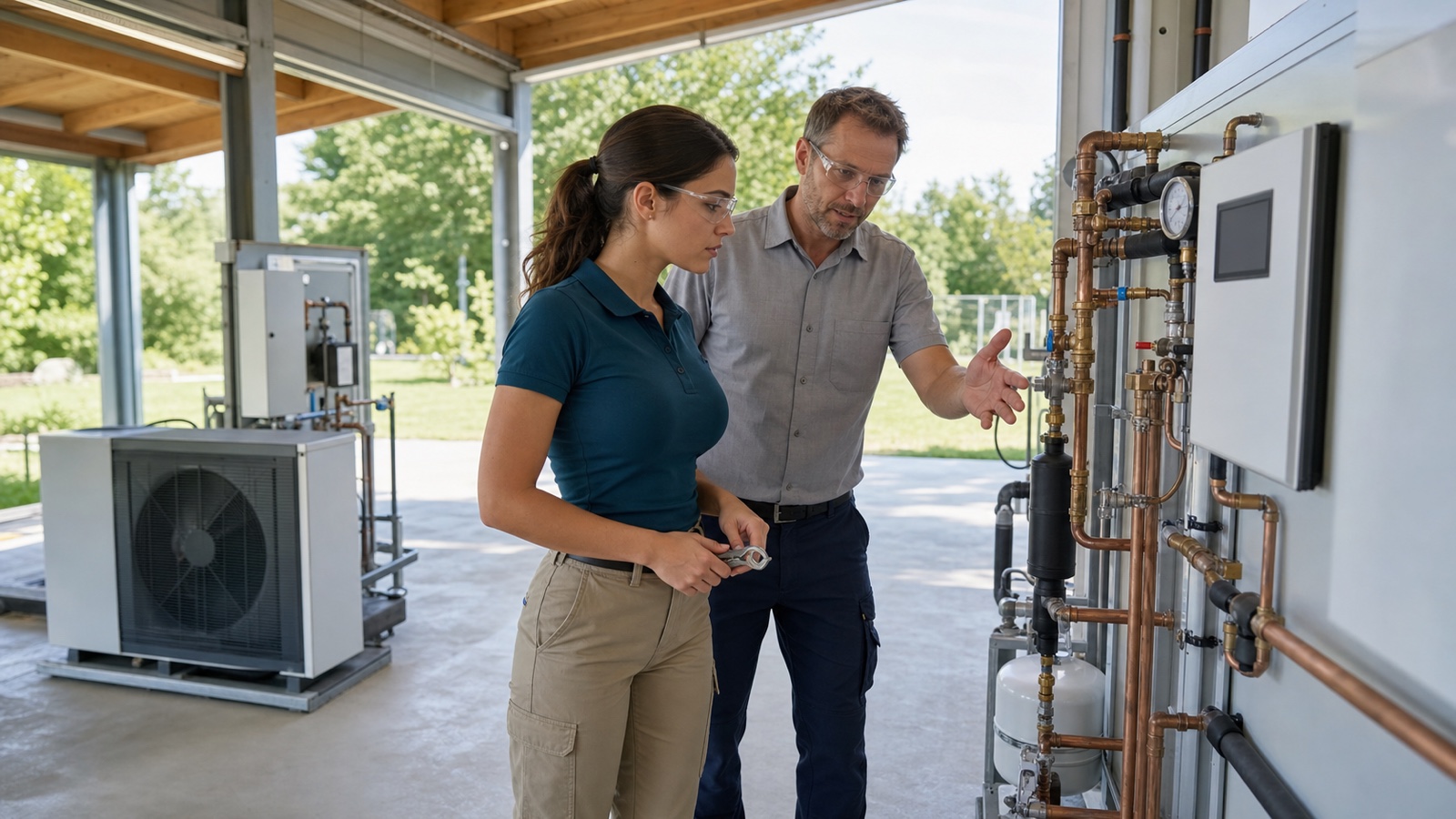
Installation and building technology will become Installation and Energy Technology from 2027. The new structure includes the main modules „Wasser und Wärme“ and „Lüftung“. The special module „Klima- und Automatisierungstechnik“ can build on that. Renewable heat, energy-efficient operation, control, commissioning, safety testing and systematic troubleshooting are being brought closer together. Details are set out in the Installations- und Energietechnik-Ausbildungsordnung.
Suitable for you if: If you want to combine practical work on construction sites with measuring devices, technical plans and automated systems. Clarify before signing the contract which main module is offered and whether the company can actually cover the specialist module.
3. Glass Construction Technology: Craftsmanship, Building Physics and Digital Planning
From 2027, glass construction technology will receive a main module and the optional specialist module "Planning and Construction". The new focuses include sustainability, climate protection and energy-efficient glazing. The specialist module adds consulting, building physics, on-site measurement, design and digital construction. The profession thus combines installation and material processing with planning, standards knowledge and CAD.
Suitable for you if: If you want to combine precise craftsmanship, design and spatial thinking. Ask when trying it out whether the daily routine is more oriented toward installation, workshop production, renovation or planning. The same apprenticeship title can have very different emphases in everyday work depending on the company.
4. Glass Shaping and Glass Finishing: Rare Crafts Will Remain Trainable
Five traditional apprenticeships with very few apprentices have been combined into a new apprenticeship since July 2026. The focuses range from glassblowing and glassmaking to glass painting, glass cutting and engraving. The aim of the consolidation is to continue craft training despite the small number of training companies.
Suitable for you if: If you bring high concentration, a good feel for materials, design skills and an interest in rare manufacturing techniques. Because there are only a few training locations, location, vocational school commute and the actual availability of apprenticeship positions should be considered particularly early in planning.
5. Preparation: Biology Meets Design and 3D Technology
The traditional apprenticeship "Specimen Preparation" has been modernized. Specialists create and restore animal specimens for museums, teaching, research, or private commissions. In addition to anatomy, conservation, and lifelike design, finished body models and 3D printing can now also be part of the work process.
Suitable for you if: Sie combine biological accuracy, artistic work, and patience. A taster day is particularly important here: the real handling of dead animals, chemical substances, and long, detailed tasks differs significantly from a purely creative idea of the profession.
6. Animal care: more species conservation, observation, and documentation
Since July 2026, animal care has been reorganized according to competence areas. Species conservation and new applications are being given greater consideration. The daily routine includes not only feeding and care but also behavioral and health monitoring, documentation, cleaning and disinfection, animal transports, maintenance of enclosures, and collaboration with scientific or veterinary professionals.
Suitable for you if: Sie should be reliable, physically resilient, and attentive and also accept routines, hygiene rules, and weekend duties. A love of animals is a good motivation, but it does not replace the willingness to carry out cleaning, follow safety rules, and keep precise documentation.
Eight more apprenticeships: what has been updated since July
Three pilot training programs are becoming regular apprenticeship occupations
Assistant in security administration, event management clerk, and industrial clerk were transferred into the regular training program after a positive evaluation. For apprenticeship seekers this creates more planning certainty: the occupations are no longer just temporary trials. However, that still says nothing about the number of open positions in a region. Search specifically for companies that are registered to train in that exact apprenticeship.
Baking technology will be permanently established
Baking technology was introduced in 2019 as a training pilot and is now becoming a regular apprenticeship occupation with a new examination regulation. The profession complements the traditional bakery with production technology, quality assurance, laboratory analyses and technological knowledge. Anyone who likes food craftsmanship but also finds larger systems and standardized processes interesting should compare both apprenticeships during trial placements.
Two training pilots are being extended
The rail travel and mobility service and the tunnel construction focus of the civil engineering specialization will run for another two years for the time being. Further adjustments to the occupational profile are to be developed for the mobility service. In tunnel construction, the extension prevents a gap while several construction apprenticeships are being redesigned. An extension is not the same as the final transfer into a regular apprenticeship occupation; therefore ask about the specific entry possibilities and the training plan.
Three final apprenticeship exams are being made more practice-oriented
The examination regulations are being changed for hairdresser (stylist), baking technology and confectionery. For hairdressers the ministry names four subjects: basic competencies, color alteration and haircut, women's service and men's service. Those already in training should not infer from a general overview which exam version applies to them personally. Entry date and transitional rules can be decisive; binding information is provided by the responsible apprenticeship office.
What the changes mean for your career choice
A modern name does not automatically make an apprenticeship occupation suitable. Conversely, a traditional job profile can be more technically demanding than it appears from the outside. Use the package as an opportunity to examine the actual day-to-day work more closely.
- Compare activities instead of titles: Do you want to assemble, advise, design, diagnose, document, or work with animals?
- Decide on module or specialization: A company does not have to offer every possible specialization. Ask about the specific entry in the apprenticeship contract.
- Experience the work environment: Workshop, construction site, laboratory, animal housing and event operations place different demands on noise, weather, physical work and working hours.
- Check the digital component: Ask which measuring devices, diagnostic programs, CAD systems, or documentation tools apprentices use.
- Check training quality: Who is the trainer, how is the onboarding organized, when do apprentices become independent and how are they prepared for the final apprenticeship exam?
- Plan for commute and vocational school: In rare occupations a long commute or block-scheduled vocational school classes may be necessary.
The AMS currently lists 229 recognized apprenticeship occupations, or 329 variants if specializations and main modules are included. Around 80 percent of the apprenticeship period takes place in the company and 20 percent in vocational school. That is precisely why not only the regulation is important, but also the quality of the specific training company.
Eight questions for the taster day and job interview
- Under which exact occupational title will my apprenticeship contract be registered?
- Which main module or specialization will actually be taught?
- Which new content from the training regulations can I learn practically in the company?
- Which machines, measuring devices, and digital tools do apprentices work with?
- Who supervises me on a daily basis, and how often do I receive feedback?
- Where is the vocational school located, and is instruction weekly or taught in blocks?
- How does the company prepare apprentices for the final apprenticeship examination?
- What hiring and further training opportunities are available after graduation?
Legally, an apprenticeship contract must concern a recognized apprenticeship occupation and be registered by the company with the apprenticeship office for entry. The WKO explains the legal key points of the apprenticeship contractand the tasks of the apprenticeship offices. Have any verbal commitments about specialization, training location, or additional modules confirmed as clearly as possible in the contract or in supplementary documents.
Three decision situations from practice
Interest in technology, but no clear focus yet
A student is interested in vehicles but is undecided between bodywork, diagnostic technology, and electromobility. Instead of just searching for 'auto repair shop', she compares companies by their future vehicle-technology focus, attends two taster days, and asks about high-voltage and assistance systems. This way she decides based on the actual training rather than an outdated job profile.
Practical work with climate benefits
A school leaver wants to do hands-on work and is interested in the energy transition. In installation and energy technology, he compares 'water and heating' with 'ventilation' and checks whether the company later offers climate and automation technology. The connection to sustainability does not arise from the title alone but from concrete systems, projects, and learning opportunities.
Creative profession with few training locations
An applicant discovers stained glass painting and engraving. The new bundling keeps these rare paths open, but regionally there are only a few companies. She therefore first clarifies the apprenticeship position, vocational school, and specialization before making housing or commuting plans. A broad alternative plan with glass construction technology or a related design profession prevents the career choice from depending on a single location.
How to proceed now
- Choose up to three of the 14 occupations whose activities match your interests.
- Read the job profile and requirements in the AMS Occupational Lexicon, not just short job ads.
- Search for current apprenticeship positions and verify the exact job title.
- Arrange a taster day and bring the eight questions from this article with you.
- Compare at least two companies by learning content, supervision, commute, and chances of being taken on.
- Before signing, check the job title, specialization, apprenticeship duration, training locations, and start date.
Our guide Find apprenticeships in Austria supports with searching, taster internships and applications. Those who have not yet considered technical pathways will find in the article Women in technology Programmes and orientation options. Our overview on the broader connection between the energy transition and qualifications explains Green Jobs.
FAQ on the Apprenticeship Package 2026
Do I have to wait until 2027 to apply?
No. Apprenticeships in the previous occupations may still be relevant. What matters is under which regulation and designation the specific entry takes place. Ask the company and the apprenticeship office how a start date around 1 January 2027 will be handled.
Does an existing apprenticeship contract automatically transfer to the new regulation?
This cannot be answered in general from the package overview. The respective regulation contains transitional provisions. Have your entry date and registered apprenticeship occupation officially checked by the competent apprenticeship office before accepting any changes.
Is a special module guaranteed to be available?
No. A module in the training regulations does not mean that every company offers it. The company must be suitable in terms of personnel and resources. Ask specifically about training authorization, learning stations, and registration.
Are modernized apprenticeships automatically better paid?
No. Apprentice pay is generally determined by the applicable collective agreement, not by how new the training regulations are. Therefore compare job content, industry, collective agreement, and development opportunities separately.
Conclusion: New regulations, but company quality remains decisive
The Apprenticeship Package 2026 brings electromobility, building automation, sustainability, digital planning, and modern exam formats more strongly into dual vocational training. At the same time it safeguards rare crafts and transitions proven training pilots into regular occupations. For applicants, this is an opportunity to look more closely: choose not just a title, but a company that convincingly, comprehensively, and with good support provides the desired focus.