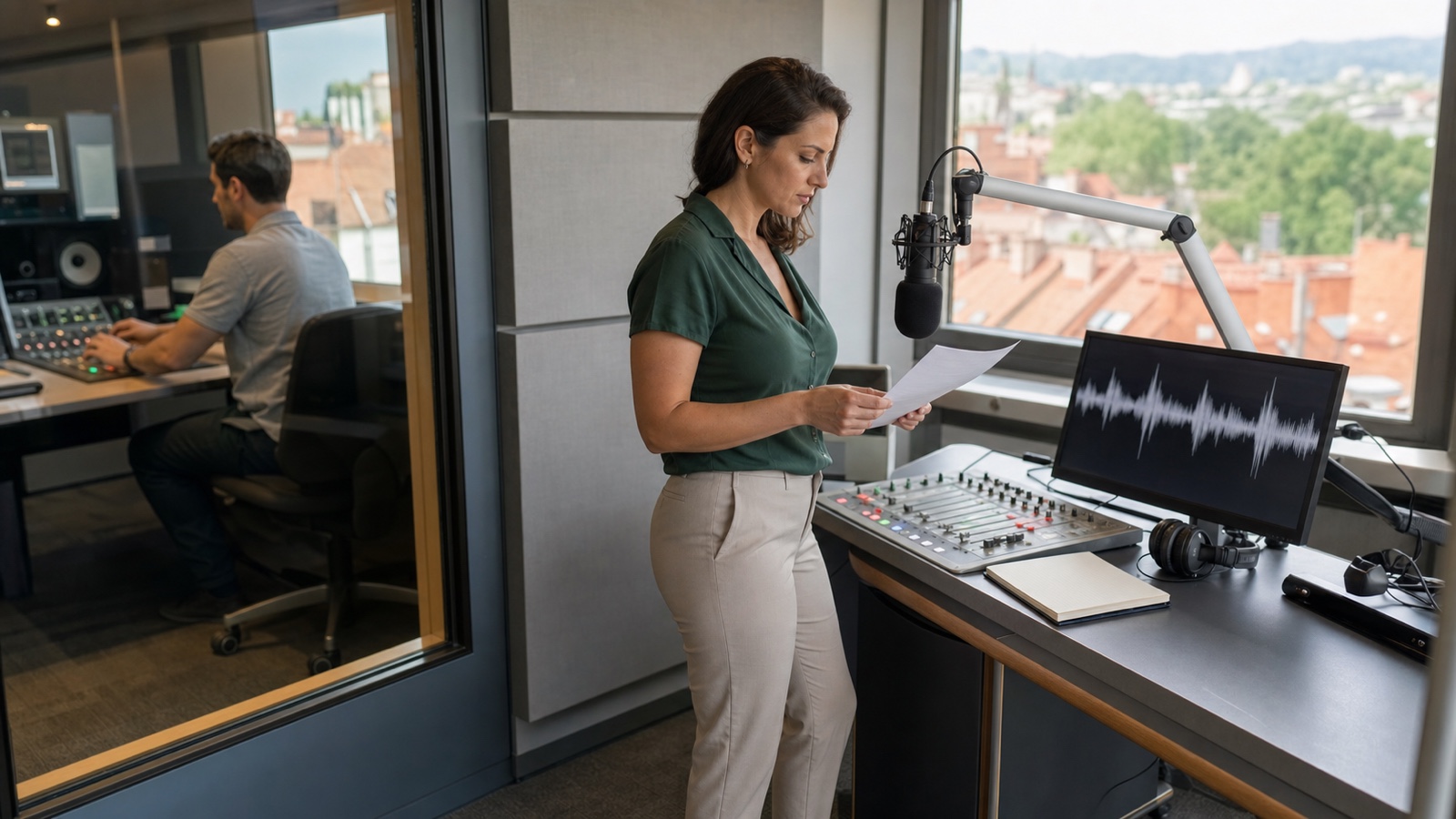
AI can transcribe interviews, pre-sort large document volumes, search data for patterns and prepare pieces for different distribution channels. But it can also mix up names, invent sources, smooth quotes and show photorealistic events that never happened. For journalists there is therefore no shortcut around editorial responsibility. The central new skill is to meaningfully limit AI and to verify every relevant result in a traceable way.
Since 2 August 2026 the transparency obligations of Article 50 of the European AI Regulation also apply. For Austrian media professions, AI in Journalismis therefore not just a question of efficient tools. It is about source criticism, labelling, data protection, rights, documentation and clear final responsibility. This guide explains which tasks can be supported, where particular risks lie and what a practical editorial workflow looks like.
The most important points in brief
- AI remains a tool: The editorial office is responsible for research, selection, contextualisation and publication.
- Text is a special case: For texts on matters of public interest the disclosure obligation can be waived if a real human review or editorial control takes place and a person or organisation bears editorial responsibility.
- Deepfakes require disclosure: Realistic-looking AI images, audios or videos can be considered deepfakes even if no real person was copied.
- Distinguish two roles: Providers of generative systems must technically and machine-readably label synthetic outputs; media companies as operators may face additional visible disclosure obligations.
- Standard editing is not automatically a deepfake: Minor colour correction, noise reduction or similar optimisations typically do not substantially change authenticity.
- Verification becomes a core competence: Sources, figures, quotes, names, rights, biases and labelling must be checked before every publication.
This article offers professional orientation and not individual legal advice. In unclear borderline cases, the editorial team, legal department, data protection officer or external counsel should be consulted.
What changed on 2 August 2026
Article 50 of the AI Act regulates transparency obligations for certain AI systems and content. The AI Service Center of the RTRdistinguishes, among other things, direct AI interaction, synthetic content, deepfakes and AI-generated texts used to inform the public on matters of public interest.
For editorial teams it is important not to lump all obligations together. The provider of a generative system must in principle equip its outputs with a technical, machine-readable label. Those who use the system professionally and publish content are typically the operators. For operators, understandable disclosures for deepfakes and certain text publications are particularly central.
The The EU Commission explains in its current guidelines, that Article 50 has been applicable since 2 August 2026. For systems that were already on the market before then, a transitional rule until 2 December 2026 can apply for the technical provider labelling. However, this is not a general deferral for every editorial disclosure. Editorial teams should therefore document system, content, publication timing and their own role separately.
The editorial text exception is not a free pass
An AI-generated or substantially manipulated text on a matter of public interest must in principle be disclosed as such. According to the RTR interpretation, the obligation is waived if the content has been subjected to human review or editorial control and a natural or legal person bears editorial responsibility.
In practice this does not mean that a quick glance at a finished AI text is sufficient. Robust editorial control must address the relevant assertions: Are sources and facts correct? Are quotes reproduced according to the original? Have uncertainties been made visible? Is the selection fair and professionally justifiable? Does the publication comply with due diligence, media law and internal guidelines?
If you cannot answer these questions, you should not publish the text or you should clearly disclose the AI usage and re-examine the piece. A name in the author field does not replace a documented editorial process.
Deepfakes: Why invented persons are also relevant
The AI Act understands deepfakes as realistic-looking image, audio or video content that resemble real people, places, objects, institutions or events and may falsely appear real. According to the current RTR interpretation, a photorealistic person without a real-life model can also fall under this if the audience might perceive the depiction as authentic.
This is particularly sensitive for news and informational content. A generated stock photo can be mistaken for documentation of a real event. A synthetic voice can create the impression of a real interview. A manipulated video can attribute words or actions to a person that never occurred.
Disclosure must be clear, unambiguous and made at first perception. For images and videos a visible label is sensible; for audio a clearly audible notice. Alt texts and technical metadata can supplement but do not automatically replace immediately perceptible information. Artistic, satirical or fictional formats may use eased forms of disclosure; purely informative pieces should not prematurely claim this exception.
Which editorial tasks AI can usefully support
Transcription and indexing
AI can make long interviews, press conferences or meetings searchable. The transcription is a working document, not a citable source. Names, figures, technical terms and every published quote must be checked against the audio, video or original record.
Sorting and summarising documents
For reports, laws or studies AI can mark topic blocks and possible contradictions. Good newsrooms can show the source and context for every claim and read the decisive passages in the original. A summary must not replace the primary source.
Exploring data
Language models can suggest analysis ideas, formulas or code. Numbers still need plausibility checks, reproducible calculations and documented filters. Spot checks are not enough when a metric carries the main claim of a piece.
Formats and accessibility
A verified article can be prepared for newsletters, audio intros, social media or easy-to-understand summaries. Adaptation must be rechecked for shifts in meaning, misleading abridgment and appropriate context. Subtitles and alt texts also benefit from assistance but require human final control.
Ideas and research questions
AI can provide counter-questions, possible perspectives or search terms. It is an ideator, not a source. What the editorial team selects, which people they interview and which evidence they publish remains decisive.
Where editorial teams need particular caution
- Live and breaking news: Time pressure increases the risk of unchecked errors and false attributions.
- Politics and elections: synthetic statements, images or videos can manipulate public debate.
- Health, justice and security: inaccurate formulations can cause concrete harm to people.
- Victims, suspects and minors: personality rights and privacy require particularly cautious handling.
- Confidential documents: unpublished documents, contact details and internal information should not be put into external systems unchecked.
- Synthetic voices and faces: consent, rights and deception effects must be clarified before production and publication.
- Automatic publishing: No system should put journalistic content live without a defined human release.
The ORF's AI guidelinesembed the human-in-the-loop principle and leave editorial sovereignty and final responsibility with staff. The AI guideline of the APA places human autonomy, harm prevention, fairness, explainability and journalistic quality standards at the centre. Both examples show: a tool is not judged solely by what is technically possible, but whether a clear use case is responsibly justifiable.
The eight-step workflow before publication
- Define the task: Specify whether AI should transcribe, sort, analyse, draft or generate image and sound. A narrow purpose is easier to verify than “Make this into a finished article.”
- Check tool and data: Use approved systems. Clarify which data may be input and whether confidential or personal information is involved.
- Secure original sources: Save documents, audio, links and datasets against which the result will be checked.
- Match facts and quotes: Verify names, positions, dates, figures, quotes and causal claims directly against the originals.
- Check selection and bias: Ask which perspectives are missing, which groups are stereotyped and whether the weighting is editorially justified.
- Assess rights and harms: Check personality rights, data protection, copyright and usage rights as well as potential consequences of a false publication.
- Decide on disclosure: Document whether a deepfake, a text on public interest or only supportive standard editing is involved. Choose a clear, accessible labelling.
- Release responsibly: A named person confirms content, method and publication. For sensitive cases, the four-eyes principle applies.
Such a process does not slow the newsroom down if templates, roles and escalation paths are prepared. It prevents every team from starting from scratch on a borderline case.
Which skills will become more important in media jobs
Source criticism and verification
Those who verify AI results must be able to find primary sources, compare original material and assess uncertainty. Classic research skills therefore gain in importance.
Method and data understanding
Editorial staff do not have to program every model. But they should recognise when an answer only sounds plausible, how a dataset was produced and which control steps make an analysis reproducible.
Law and editorial ethics
AI Act, data protection, personality rights, copyright and internal media policies interact. People are sought who recognise legal questions early and not only escalate after publication.
Transparent communication
Good labelling briefly explains to the audience what was artificially generated or substantially altered. It should neither be hidden nor give the impression that any spell-check turned a piece into an AI article.
Editorial decisiveness
Which story is relevant, which sources are credible and which depiction is fair remains a journalistic decision. This judgement distinguishes responsible media work from automated content production.
Those who want to build the fundamentals systematically can find an introduction at jobspot.at-Learning plan for AI competence on the job and in the article on digital skills in the Austrian labour market a broader perspective.
What the AMS data mean for applicants
The AMS JobBarometer for journalists shows only 62 evaluated online adverts for 2025 and a negative trend for 2026 to 2028. This number does not reflect the entire media job market: freelance work, personal networks, internal hirings and adjacent communications roles can be missing from public adverts. It nevertheless indicates that applications need a clear professional profile.
“I know ChatGPT” is not such a profile. More meaningful are concrete work samples:
- an interview with verified transcription and documented quote checking,
- a data analysis with sources, calculation steps and error checking,
- a piece with a transparent labelling decision,
- an investigation where AI only provided search directions and primary sources carry the content,
- a short editorial risk analysis for a synthetic image, audio or video.
The guide on Work samples in the application shows how to present results with starting situation, own contribution and verifiable outcome.
A 30-day learning project for media professionals
Week 1: Check a transcription
Transcribe a ten-minute self-recorded conversation. Mark every error in names, numbers, dialect and sentence boundaries. From this, formulate a personal checklist.
Week 2: Source-bound summary
Choose an official report. Let possible key statements and open questions be suggested, link each assertion to a source and remove everything the original does not contain.
Week 3: Evaluate synthetic material
Take a fictional image or audio concept. Assess deception potential, rights, disclosure, alt text and journalistic necessity. You do not have to produce the material to do this.
Week 4: Document the workflow
Create a one-page template with task, tool, input data, sources, checks, labelling decision and approval. Test the template on a short, non-sensitive announcement.
Three typical editorial cases
Case 1: Interview transcription
An editor uses AI for the transcript of an interview. She listens to every used quote in the original, checks names and context and writes the piece herself. The benefit lies in indexing; source and responsibility remain clear.
Case 2: Photorealistic stock image
A local newsroom generates a realistic-looking accident scene because no real photo is available. The audience could take it for a recording of the event. The newsroom must clarify deepfake and labelling questions and should consider whether a neutral graphic or clearly recognisable symbol image is journalistically more responsible.
Case 3: Fully automatic posting
A system creates a text from a press release and publishes it without human review. For a matter of public interest editorial review is missing; the text exception does not simply apply. Additionally, error, source and liability risks remain unresolved. The process needs a human approval before publishing.
FAQ on AI in journalism
Must every AI-assisted article be labelled?
No, not every supportive use automatically triggers a visible label. Decisive are the type of system, significance of the change, content, editorial control and responsibility. Internal guidelines can go beyond the legal minimum.
Is editorial control sufficient for AI images?
The text exception must not be transferred to image, audio and video. If the material constitutes a deepfake, disclosure is generally still required.
May AI improve quotes linguistically?
Journalistic quotes must reproduce the statement correctly. Any smoothing must be checked against the original and editorial citation rules. AI must not attribute a more concise or striking statement to someone if it was not made.
Which tools belong in an application?
Name only tools you actually master. More important than the product list is which task you solve with them, how you protect data and how you verify results.
Does AI replace journalistic training?
No. Research, media law, ethics, dramaturgy, interview technique and editorial judgement remain fundamental. AI competence complements these skills.
Conclusion: Credibility arises in the verification process
AI in journalism can reduce routine work and open up new research possibilities. Its professional value only becomes apparent when newsrooms organise task, data, sources, control and disclosure properly. Especially for public topics, photorealistic images, voices and videos technical skill alone is not enough.
For media professionals a combination therefore becomes decisive: journalistic diligence, AI competence, legal awareness and transparent communication. Those who prove these skills with verifiable work samples demonstrate not only tool knowledge but the judgement that credible media continue to need.
Sources and further information
- RTR AI Service Desk: Transparency obligations under Article 50 AI Act
- European Commission: Guidelines on transparency obligations, updated 29 July 2026
- ORF: AI guidelines and human-in-the-loop principle
- APA: Guideline for dealing with artificial intelligence
- AMS JobBarometer: Journalist in Austria
- RTR: 2026 guidelines for promoting quality journalism