Artificial intelligence does not drive across the field alone, nor does it independently decide what a farm should grow.However, it can evaluate image, sensor, weather, and machine data, create forecasts, and make unusual developments visible earlier. In doing so, it is changing tasks in agriculture, agricultural engineering, and consulting. People who combine digital results with experience in the field are becoming particularly valuable.
For Austria, this is more than a future scenario. Current research projects are testing explainable AI for crop production and irrigation, a professorship for data-oriented AI in agriculture is being established in Wieselburg, and a free online course teaches Precision Farming. This guide shows where AI in agriculture is already being applied in practice, which professions benefit from it, and how specialists can build a robust competence profile.
Why AI on Austrian farms is a skilled labor issue
Agricultural decisions depend on many factors: soil, variety, weather, pest pressure, water availability, machinery, costs, and legal requirements. Digital systems increase the amount of information available. However, they do not automatically solve the question of which information is truly relevant for action on a specific farm.
The Federal Ministry of Agriculture and Forestry describes digitalization and precision farming as an opportunity for more efficient and ecological use of operating resources. With the Innovation Farm at the Wieselburg, Raumberg-Gumpenstein, and Mold locations, there is an Austrian testing and mediation structure for this. The free APOS correction service also supports high-precision satellite-based positioning.
Such infrastructure only becomes useful through qualified application. A farm needs people who can correctly use sensors, check data sets, professionally assess models, and operate machines safely. In consulting and technology, translation tasks are added: What does a model value mean for the next work step, and when is an on-site inspection more important than the digital recommendation?
Distinguishing between Precision Farming, automation, and AI
The terms are often mixed up. For job applications and further training, a clear separation is worthwhile:
- Digitalization makes information electronically available, such as field records, machine data, or weather logs.
- Precision Farming manages areas more precisely in terms of space and time, for example with GNSS, section control, or application maps.
- Automation executes defined processes according to rules, such as steering along a planned track.
- AI recognizes patterns in data, classifies images, estimates states, or creates forecasts and recommendations.
In practice, these levels interlock. AI-based weed detection is worthless if the camera is dirty, the plants look different in the training data set, or the machine does not reliably implement the information. Agronomic knowledge, clean data, and functioning technology therefore remain part of the same work chain.
Five applications that are changing tasks on the field and farm
1. Recognizing plants and weeds in images
Cameras on machines, mobile devices, or stationary systems provide large amounts of image data. AI can distinguish plant species, estimate development stages, or mark suspicious areas. This allows inspections to be planned more specifically and operating resources to potentially be used more accurately.
The Austrian FFG project CultivateAnything runs from 2026 to 2029. It is researching hybrid AI for adaptable, explainable, and certifiable applications in precision agriculture. A focus is on new, rare, or invasive species for which only a few training data are available. This shows the central challenge: A model must be able to deal with unknown situations without faking certainty.
2. Better estimating the right time for measures
Sowing, irrigation, fertilization, plant protection, and harvesting are time-critical. AI can combine weather data, plant observations, and development models to narrow down time windows. The decision remains farm-specific, however, because trafficability, labor, machine capacity, and local experience must be taken into account.
Exactly this is what the FFG project PhenAI is working on in the years 2026 and 2027. A hybrid plant model is intended to predict phenological development phases and thus support the scheduling of agricultural measures. This does not result in a purely operational task for employees: they must understand input data and forecast quality and document deviations.
3. Forecasting soil moisture, yield, and irrigation
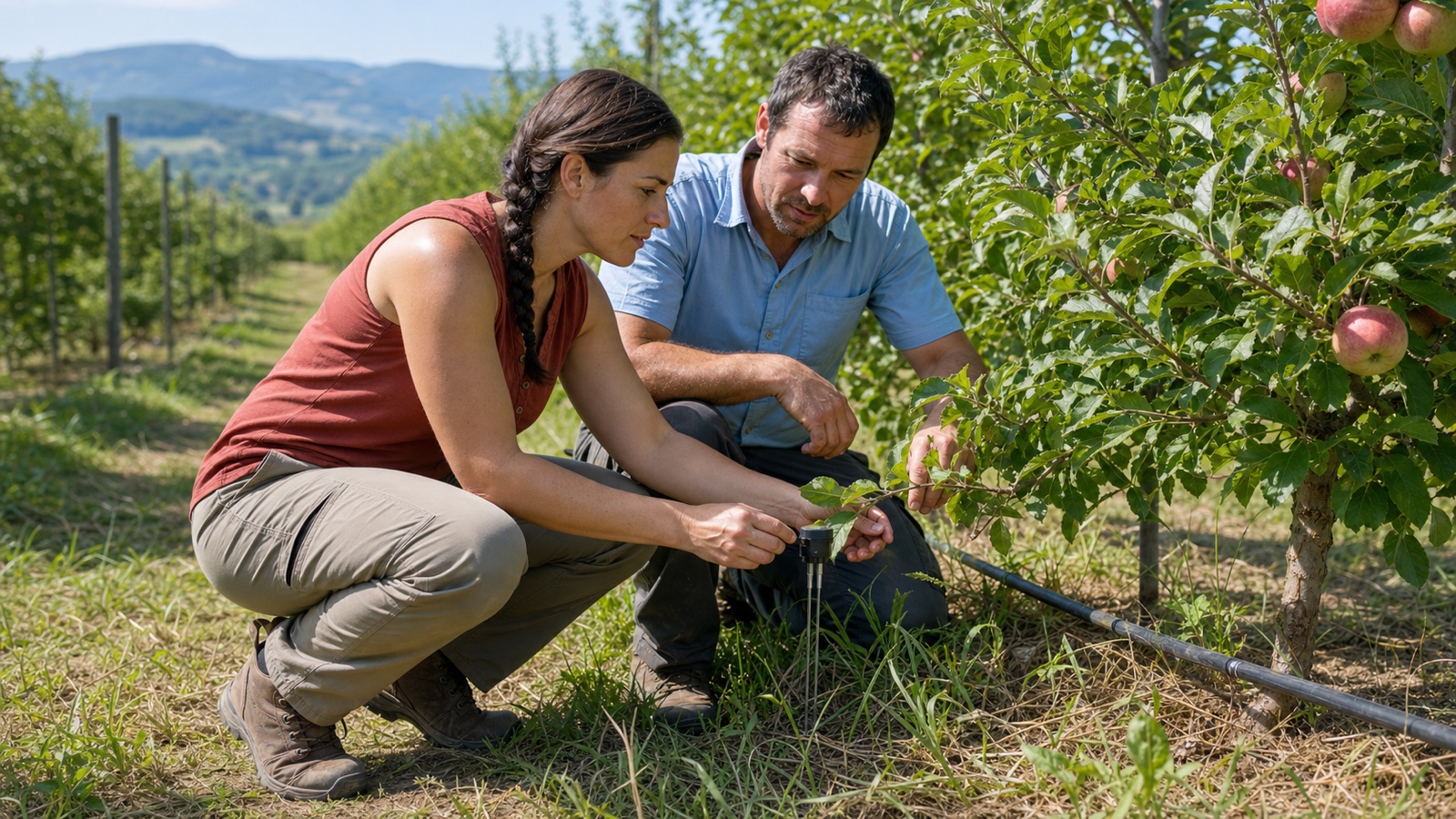
Satellite images, weather data, soil data, and local measurements can together provide a more accurate situational picture. The FFG project AISAAC is developing explainable AI for yield, soil moisture, and irrigation for this purpose. The project period runs from 2025 to 2027.
The benefit does not lie in a single number on the screen. The decisive factor is whether specialists recognize when a sensor fails, cloud cover impairs satellite data, or a model maps an area too coarsely. Only then can it be assessed whether an irrigation round should be postponed, a sub-area checked, or an assumption corrected.
4. Using operating resources specifically for sub-areas
Application maps and sensor values can support machines in applying seeds, fertilizer, or plant protection products in a spatially differentiated manner. At the Innovation Farm in the arable farming project area, topics such as soil cultivation, sowing, fertilization, plant protection, data management, and satellite observation are covered.
Anyone who manages such systems needs several perspectives at once. The agronomic question is which measure makes technical sense. The technical question concerns calibration, interfaces, and machine settings. The economic question clarifies whether effort and benefit fit the farm. AI can provide patterns, but cannot replace these three checks.
5. Planning maintenance and technical support more specifically
Agricultural machines generate operating, error, and sensor data. Models can prioritize anomalies and provide hints for troubleshooting. However, a warning signal is not yet a diagnosis. Technicians must check whether wear, operation, software, sensors, electrical systems, or operating conditions are the cause.
This increases the importance of roles at the interface between the workshop, the field, and digital support. People who understand mechanics and electronics and can simultaneously comprehend data translate an automatic message into a safe repair or operational decision.
Which tasks explicitly remain with humans
Assessing local conditions
A model only knows the information available to it. Compacted tracks, small-scale soil differences, game damage, a clogged nozzle, or a short-term weather change can change the result. Field inspection and experience remain indispensable.
Ensuring data quality
Incorrectly placed sensors, inaccurate area boundaries, missing calibration, or inconsistent designations lead to poor results. Good data work therefore does not start with complicated models, but with comprehensible recording, plausibility checks, and documentation.
Taking responsibility and ensuring safety
A recommendation must not override any machine or occupational safety rule. Anyone who operates, maintains, or releases a system needs clear responsibilities. In the case of uncertain results, it must be determined when a system should be stopped, a specialist consulted, or a proven procedure resorted to.
Making economic decisions
Not every technically possible application pays off on every farm. Acquisition, subscription, data connection, training, maintenance, and additional documentation effort belong in the calculation. Equally important is the question of whether data can be exported and what happens when changing providers.
Five job profiles with good connection opportunities
Farmer or farm manager
The core competence remains production. Added to this is the selection, introduction, and control of digital tools. A profile that can solve a concrete operational question, such as documenting water consumption, comparing stocks, or reducing machine times, is particularly convincing.
Agricultural consultant or crop production consultant
Consulting translates data into professional options. This requires knowledge of varieties, soil, and stocks as well as the ability to explain model limits in an understandable way. Consultants should not only present recommendations but also make assumptions and uncertainties visible.
Agricultural and construction machinery technician
Mechanics, hydraulics, electronics, sensors, and software are growing together. The AMS JobBarometer shows 2,738 online job advertisements for agricultural and construction machinery technology in 2025 and rates the trend for 2026 to 2028 as tending to be positive. A particularly large number of advertisements were counted in Lower Austria with 653 and in Upper Austria with 645, followed by Styria with 354.
These figures do not prove that AI alone creates additional jobs. However, they show a relevant Austrian labor market for technical roles to which digital diagnostics, sensors, and precision farming connect well. Anyone planning to enter the field will find further orientation in the overview of technical jobs and training paths.
Agronomic data or GIS specialist
This profile combines geodata, remote sensing, statistics, and agriculture. Tasks range from area analyses and data cleaning to the evaluation of model results. A computer science degree can help, but does not replace an understanding of crop production and operational processes.
Product consulting, sales, and training
Manufacturers and service providers need people who introduce systems, train customers, and pass feedback on to development teams. Credible is someone who can explain functions in concrete work steps and openly addresses limits.
Eight competencies that employers can practically check
- Agronomic basics: Understand soil, plant development, operating resources, and typical work processes.
- Sensors and positioning: Classify measurement principles, GNSS, RTK, calibration, and possible error sources.
- Data quality: Recognize missing values, outliers, units, and implausible results.
- Checking AI results: Consider confidence, comparative values, and application limits instead of just looking at an output.
- Using geodata: Read map layers, area boundaries, satellite images, and spatial differences.
- Observing machine safety: Translate digital suggestions into safe, approved work steps.
- Clarifying data rights: Check export, access, storage, and vendor dependency before introduction.
- Communicating understandably: Explain technical findings in a comprehensible way for farm management, the workshop, and consulting.
No one has to master all eight areas at an expert level. For an application, a T-profile makes sense: solid basic knowledge across the entire work chain and demonstrable depth in one focus area, for example, agricultural technology, crop production, GIS, or data analysis.
Building a presentable learning project in 30 days
Week 1: Define an operational question
Choose a narrow task, for example: How can soil moisture data be validated? What information does sub-area-specific fertilization need? How is a machine warning checked in a structured way? Note the goal, available data, safety limits, and success criterion.
Week 2: Learn basics in a targeted manner
The Francisco Josephinum presented a free online course on Precision Farming in July 2026. Five micro-credentials, each with around 25 hours, cover basics, arable farming, data processing and AI, viticulture, and robotics. Anyone who completes all units can acquire the "Precision Farming Specialist" qualification.
First, choose the unit that fits the learning project. Document not only completed lessons, but three insights, two open questions, and one possible application.
Week 3: Check data and results
Work with a small, legally available data set or with self-recorded measured values. Check units, timestamps, missing values, and outliers. Then create a simple evaluation or decision matrix. It is not important to train your own AI model, but to evaluate the quality of a digital recommendation in a comprehensible way.
Week 4: Create a work sample and reflection
Summarize the initial question, data basis, test steps, result, uncertainties, and next measure on two pages. Add screenshots or a simple graphic only if no confidential farm data is visible. This work sample shows employers more than the general statement that one is interested in AI.
Three practical cases for application and further training
Irrigation in fruit or viticulture
Combine soil moisture, weather forecast, and plant observation. Describe at what measurement error you would check a sensor and which decision never follows only from a model value.
Weed detection in arable farming
Compare digital classification with a spot check on site. Note which plants are confused, how light and development stage influence the result, and when an automatic recommendation must be blocked.
Digital diagnostics in agricultural technology
Develop a test procedure from error message to visual inspection and measurement to repair decision. Show which information comes from the system and which qualification is required for the intervention.
How AI competence becomes credible in an application
A good application does not list a long list of tools without context. It connects task, procedure, and result. A suitable resume point could be: "Checked soil moisture and weather data for three areas, documented faulty sensor values, and reconciled irrigation decisions with field checks."
In an interview, concrete answers to four questions help:
- Which operational problem should be solved?
- How were data and results checked for plausibility?
- Which decision consciously remained with a specialist?
- What would you improve in the next run?
Anyone looking for a sustainable career path can also combine such digital skills with opportunities in Green Jobs in Austria. Agricultural knowledge, resource efficiency, and technology are a particularly robust combination.
What farms should clarify before introduction
Before purchasing or pilot operation, those responsible should not only compare functions. They need a clear deployment process:
- Who is professionally responsible for the output and who for the technical function?
- Which data is recorded, where is it stored, and how is it exported?
- How is performance tested under Austrian operating conditions?
- What happens in the event of a dead spot, sensor failure, or implausible result?
- What training do operators, consultants, workshops, and management need?
- How are wrong decisions, corrections, and learning experiences documented?
The Austrian AI service center of the RTR emphasizes regarding AI competence according to the AI Act, that technical, legal, and ethical knowledge must fit the role and the context of use. A general introductory lecture is therefore not sufficient for all tasks. For a structured implementation, the in-depth jobspot guide on AI competence in everyday professional life.
also helps. Education is also building capacity. The Francisco Josephinum reported in May 2026 on a new professorship for data-oriented AI in agriculture, together with the FH Wiener Neustadt and with around 1.5 million euros in support. The appointment was planned for 2026. This strengthens the connection between research, teaching, and agricultural practice in Wieselburg.
FAQ on AI in agriculture
Do I need a computer science degree for an AI job in agriculture?
No. For many roles, agronomic, technical, or consulting knowledge is the starting point. The decisive factor is being able to check digital results and translate them into safe work steps. For development and advanced data analysis, in-depth computer science or statistics knowledge is useful.
Which further training is suitable for getting started?
Start with precision farming basics and a small practical project. The free course from the Francisco Josephinum offers current Austrian content for this. Depending on the target role, supplement with sensors, GIS, agricultural technology, crop production, or data analysis.
Does AI replace agricultural experience?
No. Models can provide patterns and forecasts, but cannot fully map local conditions, machine safety, economic efficiency, and responsibility. Experience becomes even more important where digital outputs must be checked and reasonably corrected.
What questions should I ask a technology provider?
Ask about data sources, regional testing, known error cases, export options, support, updates, costs, and behavior in the event of failures. Let them explain how uncertainty is displayed and which decisions a specialist must confirm.
Conclusion: Agricultural knowledge becomes more valuable through digital judgment
AI in agriculture is not a single profession and not an autonomous solution. It is an additional layer of tools between field observation, sensors, machines, and operational decisions. Austrian research, education, and practical offers show that this field of work is already growing concretely.
The best chances are for specialists who not only operate technology but also check results, name limits, and justify measures in a comprehensible way. A small documented learning project is the most sensible next step for this: choose a real question, check data, derive a decision, and record where human experience remains indispensable.