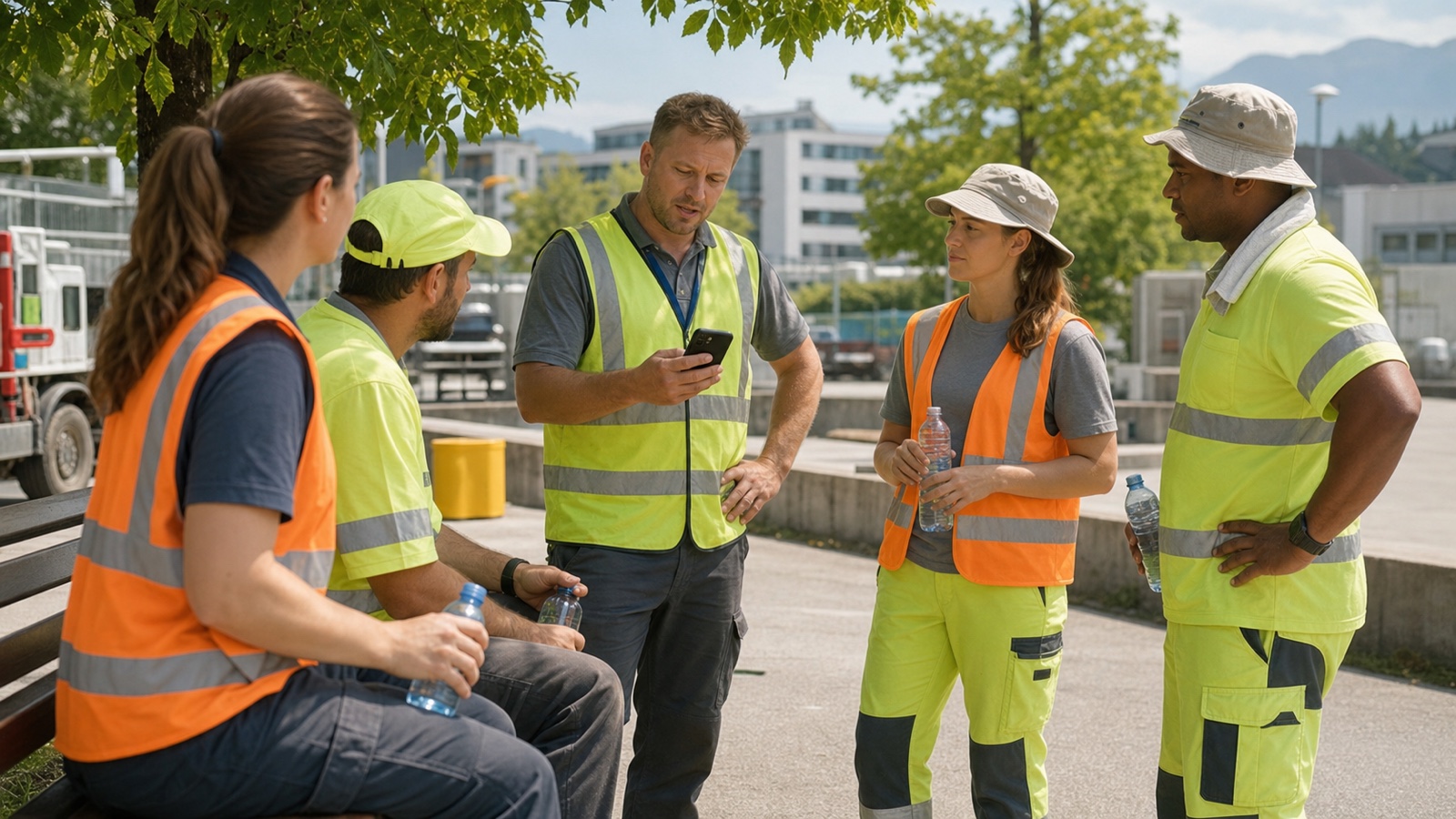
The first summer under the new heat protection regulation is a real practical test for many Austrian companies. What was often handled so far as a matter of common sense, company agreement or site routine is now much more concretely regulated: those who work outdoors should be systematically protected from heat and natural UV radiation. For employees this is more than a health issue. Heat protection affects working hours, breaks, equipment, deployment planning and thus also the question of how attractive a job really is.
Especially in physically demanding jobs — in construction, logistics, transport, cleaning, emergency services, agriculture or municipal services — heat becomes a recruiting factor. Applicants pay attention not only to salary but also to whether an employer organizes everyday work realistically. For companies, good heat protection thus becomes part of occupational safety, staff retention and employer branding.
What is new now
The Heat Protection Ordinance, short: Hitze-V, has applied since 1 January 2026. It creates a separate legal framework for outdoor work when employees are or may be exposed to heat or natural UV radiation. Included are, among others, outdoor workplaces, construction sites and off-site work locations. Short outdoor tasks are excluded; for agriculture and forestry there is an additional specific regulation.
The core of the new rules is not a blanket “heat day off”, but a mandatory process: employers must identify hazards from heat and UV radiation, assess them and define appropriate measures. These measures must be implemented when GeoSphere Austria issues a heat warning of at least level 2. Perceived temperature plays an important role here, because not only air temperature matters but also sun, wind, humidity and physical exertion.
The Ministry of Social Affairs justifies the new rules with a working world increasingly affected by heat waves. A foundational report by Gesundheit Österreich GmbH points out that hot days in Austria have already multiplied significantly compared with the climate period 1961 to 1990. For companies this is no longer a marginal issue but a predictable burden: routes, shifts, construction site workflows and service times must be organized so that health and safety do not depend on spontaneous improvisation.
Which obligations employers specifically face
Employers should know before the hot season which tasks are particularly risky. These include heavy physical work, direct sunlight, reflective surfaces, asphalt, roofs, protective clothing, vehicles without adequate cooling and deployment locations without shade. From this a program of measures must be developed, often referred to as a heat protection plan.
Typical measures are an earlier start to work, moving particularly strenuous tasks to cooler times of day, additional breaks, shaded rest areas, drinking water or other non-alcoholic beverages, suitable headwear, UV-protective clothing, sunscreen, technical shading and a clear emergency routine for heat stress. When multiple employers are present at one site, for example on a construction site, protective measures must be coordinated.
Instruction is also important. Employees must know how to recognize heat stress, which warning levels are relevant, which break rules apply and whom to contact. Heat protection is therefore not only an equipment list but a leadership task. Those who train new employees in summer should explain the topic already during onboarding.
Is there “heat-off” in Austria?
There is no general right in Austria to leave the workplace independently because of high temperatures. However, the Chamber of Labour points out that employers must implement protective measures when heat endangers health. Employees should therefore document problems, inform supervisors or safety representatives and, if available, involve the works council.
Special rules under the Construction Workers Inclement Weather Compensation Act apply to construction workers and certain related occupational groups. At very high temperatures, outdoor work can be stopped under certain conditions; the Chamber of Labour cites the familiar threshold of 32.5 degrees Celsius and refers to the inclement weather compensation via the BUAK. But this is not a general rule for all sectors; it is a sector-specific special provision.
What applies to offices, retail and production
The new Hitze-V is primarily aimed at outdoor work. For indoor workplaces the provisions of the Workplace Regulations continue to apply. The Labour Inspectorate lists orientation values for indoor workspaces of 25 degrees Celsius for low physical exertion and 24 degrees Celsius for normal physical exertion. If these values cannot be maintained due to summer weather, employers must take measures to lower the temperature.
In practice this can mean: ventilating early, reducing direct sunlight with blinds or shades, shielding heat sources, using fans or ventilation sensibly, shifting start times, planning physically strenuous tasks differently and providing sufficient drinks. In office jobs heat is often less visible than on a construction site but can still significantly affect concentration, error rates and well‑being. Here too, a clear summer plan pays off.
Why heat protection is a recruiting topic
Many open positions are decided not only by tasks and salary but by the quality of everyday work. Employers who demand “physical resilience” in job ads should in 2026 also be able to explain how exertion is limited. This is especially important in do‑it jobs, where companies already compete for reliable staff. An employer who takes shift planning, breaks, water, shade and protective equipment seriously appears more professional than one that treats heat as a private trial by ordeal.
For applicants, heat protection is therefore a legitimate topic in interviews. Good questions include: How are outdoor deployments planned during heat warnings? Are there cool break areas? Who decides when heavy tasks are postponed? What clothing or personal protective equipment is provided? How are new employees instructed on heat stress and UV protection?
Such questions signal not a lack of commitment but professional risk awareness. Those expected to work reliably in summer need conditions in which performance is safely possible. That also applies to older employees, people with preexisting conditions, career starters and employees returning after a long absence to physically demanding work.
Checklist for employees
Employees should in particular pay attention to five points. First: Is there clear information about heat warnings and daily planning? Second: Are drinking water, shade and breaks actually available or only theoretically provided? Third: Are heavy tasks moved to cooler hours when possible? Fourth: Are head protection, UV‑protective clothing and sunscreen taken seriously? Fifth: Is there an identifiable contact person if heat causes complaints?
If several of these points are missing, it is a warning sign. In existing employment relationships employees should raise the issue factually and cite concrete examples: time, place, task, missing measure and health impact. In the application process a look at the wording of the ad helps. Phrases like “resilient”, “flexible” and “outdoor work” should be supplemented by comprehensible information on occupational safety and organization.
Checklist for employers and HR
For employers the key question is: Is heat protection already organized before the first heat wave? This includes an updated workplace assessment, a list of heat‑relevant tasks, a measures plan per site or type of deployment, defined responsibilities, instruction, documentation and a communication routine for warning levels. HR and recruiting should know this plan so that promises made in the hiring process match daily practice.
A short note in job ads can help: for example regulated summer working hours, high‑quality protective equipment, air‑conditioned vehicles, cool break rooms or structured breaks. That does not replace legal obligations but makes it visible that the company is prepared. Especially for hard‑to‑fill positions this can make a difference because candidates can compare concrete working conditions.
Internal link ideas for career planning
Those planning their next career steps should not consider heat protection in isolation. Working conditions, continuing education and age interact. On jobspot.at the articles Do‑it‑Jobs Austria 2026, Jobs 50 plus Österreich 2026 and Weiterbildungszeit Österreich 2026are a good fit. They show how important realistic working conditions, fair job interviews and development opportunities have become in the Austrian job market.
Conclusion: Heat protection belongs in every good job decision
Heat protection at the workplace in 2026 is not a summer extra but part of modern work organization. The new ordinance forces companies to act more proactively for outdoor work. At the same time, offices, retail, production and mobile activities should also review their routines because heat affects concentration, accident risk and health.
The most important piece of advice for employees is: ask specific questions before the first heat wave arrives. For employers: those who organize heat protection well not only protect their workforce but also improve their chances in recruiting. Good jobs in summer can be recognized by whether safety, planning and respect still work at 30 degrees and above.
Sources
- Ministry of Social Affairs: Working in heat, new rules 2026
- Labour Inspectorate: Working in heat outdoors
- Labour Inspectorate: Indoor climate and ventilation in workspaces
- Chamber of Labour: Working in heat
- WKO: Heat Protection Ordinance since 1 January 2026
- RIS: Federal Law Gazette II No. 325/2025, Heat Protection Ordinance