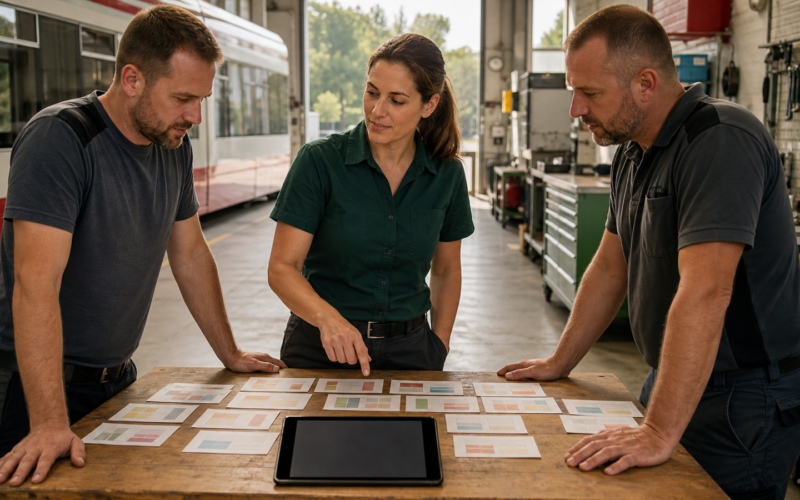
A machine sounds different, a bearing gets warmer, or a drive draws more current than usual. Experienced professionals often notice such changes early. Artificial intelligence can compare sensor data over long periods and provide indications of possible wear. It can thus help to plan maintenance better. However, it must neither replace manufacturers' specifications nor independently declare a machine safe. Maintenance remains the responsibility of skilled professionals.
This guide shows how Austrian companies can gradually introduce predictive maintenance. The focus is on safe workflows, traceable alerts, and the practical knowledge of employees. The goal is not to collect as much data as possible. The aim is to make a robust decision: what will be checked, when, by whom, and under what protective measures?
What predictive maintenance actually means
In classical preventive maintenance, parts are inspected or replaced at fixed intervals. Condition-based maintenance uses measurements such as temperature, vibration, pressure, noise, or current draw. Predictive Maintenance attempts to infer from these when a deviation might become relevant. The WKO service initiative AI Austriamentions production and maintenance — from sensor technology to Predictive Maintenance — as an operational application area.
A forecast is not a certainty. An unusual value can indicate wear, but it can also be caused by changed loading, ambient temperature, new material, or a faulty sensor. The system should therefore display the reasons, the comparison period, and the uncertainty. Technicians combine this notice with a visual inspection, manufacturer documentation, and knowledge of the equipment.
Security takes precedence over availability
Maintenance and troubleshooting work are particularly dangerous because protective devices are opened, energy sources are isolated, or unusual conditions are investigated. The Inspection of work processesstates that work equipment must be kept in proper condition throughout its service life and that safety-relevant parts must be regularly maintained. Competent persons and prescribed maintenance logbooks remain required regardless of any AI solution.
An algorithm must not shorten or shortcut a protective measure. Even if it reports “low risk of failure”, lockout, securing against re-energization, verification of absence of energy and other operational requirements still apply. Conversely, a warning signal does not justify an improvised intervention on a running machine. The safe response is specified in advance in a work instruction.
Start with a clear problem.
Many projects fail because data is collected first and only later is a question asked. A better approach is a limited use case: reduce unplanned bearing failures on a specific asset, detect compressed air leaks earlier, or better prepare a pump’s maintenance windows. This requires a known failure history, measurable consequences, and a team that understands the asset.
For the pilot, the objective and boundaries are documented in writing. Example: "The system provides an additional inspection alert for Warehouse A. It does not change machine parameters, does not trigger an automatic shutdown, and does not replace required inspections." This ensures shift personnel, maintenance, occupational safety, and management know what the pilot can and cannot do.
The onboarding journey in eight steps
- Define system and risk boundaries: Which component, which failure, and which safety consequences are the focus?
- Secure manufacturer information: Maintenance intervals, thresholds, operating modes, and permissible measurement points are documented.
- Capture experiential knowledge: Skilled personnel describe typical noises, odors, temperatures, and signs.
- Check data quality: Sensor position, calibration, timestamps, failures, and changed operating conditions become visible.
- Test warning logic: Historical known cases and normal exceptional conditions are evaluated separately.
- Define response: For each warning level, it is specified who performs which safety check within what time frame.
- Human approval: Maintenance orders and interventions are decided by qualified personnel.
- Measure impact: False alarms, overlooked defects, downtime and safety observations are evaluated together.
Example from a production facility
An Upper Austrian company monitors the vibration of a conveyor belt bearing. The model detects a slowly increasing value and reports a deviation compared to a comparable load. The maintenance technician sees not just "red" on the dashboard, but the time progression, sensor status, and similar past cases. She checks the lubrication, mounting, and temperature in the intended safe state. In doing so, she discovers that a recently changed material mixture has increased the load; the bearing itself is unremarkable.
The case is documented as an explained false alarm. The team adds the material type as context and does not simply adjust the limit value upwards. The next time a notification occurs, the system detects a different progression. This time, the expert inspection confirms the onset of wear, and the replacement is scheduled for a planned downtime window. The benefit comes from learning and process discipline, not from blind trust.
Data quality is part of maintenance
A model can only work with what sensors and systems provide. Missing timestamps, swapped sensors, new firmware, or changed positions can simulate trends. Therefore, sensor ID, installation location, calibration, and maintenance belong in a data sheet. Changes are versioned. If the data gap is too large, the system must report "no reliable statement".
Event data also requires uniform terms. "Defect", "malfunction", "planned replacement", and "no error found" are not the same. Specialists should be able to select and supplement completion reasons. Free text can be suggested in a structured way by AI, but the person confirms the assignment. Otherwise, the model learns from inconsistent or incorrect labels.
Make experiential knowledge visible, do not devalue it
Employees know peculiarities that are not in any sensor curve: a certain noise during a cold start, material dust after a product changeover, or a harmless vibration at a defined speed. A pilot project should incorporate this knowledge early on. Interviews, joint plant tours, and commented historical cases provide better rules than a finished dashboard that is only explained retrospectively.
Warnings must not be misused for individual performance monitoring. If a maintenance team closes many notices, that does not prove poor work nor a problematic shift. They may be working on the most critical asset. Metrics relate to asset condition and process quality, not to a personal ranking. Transparency strengthens the willingness to report observations honestly.
Manufacturer documentation remains binding
The Work inspection for workplace evaluation of machines betont Betriebsanleitung, vorgesehene Wartung, Verschleißkriterien und Qualifikation. An AI prediction can suggest an additional maintenance window; it must not autonomously extend prescribed intervals. If a process is to be changed, manufacturer specifications, the risk assessment and the responsible specialists must be involved.
New sensing technology must not impair protective functions. Installation, cabling and data transmission are technically checked. A cheap wireless sensor is not a good solution if it can come loose, violate hygiene requirements, or create a safety risk. The measurement must suit the environment.
Warning levels that people understand
Three clear levels are often enough. “Observe” means: check the value on the next regular round. “Check promptly” creates an order for an expert inspection within a defined window. “Safety-relevant” activates the operational emergency or shutdown process. Each level shows the reason, the affected component, data quality and the intended response. Colors alone are not sufficient.
Thresholds are not optimized only for a few failures. The team also considers false alarms and overlooked events. A system that is too sensitive will be ignored; a system that is too quiet creates a false sense of security. Changes to models and thresholds require approval, a version number and a fallback option.
Plan for data protection and cybersecurity
Machine data may seem impersonal, but can indirectly expose shift schedules, operator actions, or work performance. Before the pilot, it will be determined whether personal data is involved and which analyses are truly necessary. Access is role-based, raw data is not stored indefinitely, and exports are auditable. The WKO guideline on "AI and legal framework reminds of data protection and other applicable rights.
Networked sensors and maintenance platforms also expand the attack surface. Credentials, updates, network segmentation, logging and secure remote maintenance should therefore be part of the deployment. The system should not have unnecessary write access to machine control systems. For a pure notification process, read access is often sufficient.
Metrics for an honest pilot
- Percentage of alerts that led to a relevant technical observation
- Number and effort of unnecessary inspections
- Defects overlooked despite available data
- Lead time between alert and confirmed maintenance need
- planned instead of unplanned downtime
- Data gaps, sensor errors and unexplained model changes
- Feedback from professionals on clarity and safety
A saved hour is not a success if it results in risky interventions or persistent false alarms. The existing jobspot article on AI quality control shows, additionally, how inspection notes and human approvals interact in production processes.
From model alert to a safe work order
Between warning and maintenance there is a crucial translation step. A model may detect, for example, increasing vibration, but the work order must contain concrete, safe tasks: identify the asset, document the condition, obtain approval, secure energy sources, and work through the designated inspection points. The AI must not generate an improvised repair manual. The work order and checklist originate from approved manufacturer and operating documentation.
The work order also shows which qualifications are required and which spare parts or measuring equipment should be prepared. This makes an alert practically usable without preempting the technical diagnosis. After the work, the technician confirms the finding, the measure taken, and the result. "No fault found" is just as important as a replaced part because it improves future warning logic.
A maintenance work order must not be closed automatically just because measurements appear normal again. The equipment may have been operated at a reduced speed or a sensor may have failed. Completion requires a designated person and a documented review. Additional approvals are required for safety-critical components.
Small businesses can start small
Predictive maintenance doesn't require a fully connected factory right away. A small operation can start with a critical pump or compressor and collect a few reliable measurements. What matters is that there are enough known normal and failure cases. If only two failures have been documented, the system should not promise a seemingly exact remaining useful life.
Often a simple trend rule initially delivers more benefit than a complex model. Only when data quality and the response process are working will the analysis be expanded. The WKO document on "AI and Predictive Maintenance can serve as an introduction to typical applications. Selection and implementation must be appropriate for the specific installation.
For the business case, sensors, integration, training, false alarms, reliable inspection time, and ongoing maintenance are taken into account. Prevented downtime is a possible benefit, but not a guaranteed saving. A pilot ends with a deliberate decision: scale up, adapt, or stop.
Shift handover and communication
Warnings lose their value if they remain in a personal inbox during a shift change. Therefore, open notices belong in a shared, role-based handover process. The incoming shift sees status, last inspection, next deadline and the responsible person. Free-text summaries can be prepared by AI, but must be based on the actual orders and measured values.
The language must remain unambiguous. “Monitor the plant” needs a time and a specific measurement point. “Check soon” is too vague. In cases of acute danger, existing alarm and shutdown procedures apply; a chat message does not replace them. Teams rehearse this handover with realistic but safe scenarios.
Production planning and purchasing also need selected information, such as a possible maintenance window or a required spare part. They do not need all raw data. Role-based views keep the process clear and reduce unnecessary access.
For planned shutdowns, a clear response to all affected teams is also required. Production confirms the time window, maintenance confirms the required personnel and tools, and occupational safety confirms the planned protective measures. If a date is rescheduled, the original warning remains open and is given a new review date. This prevents a relevant signal from disappearing between the calendar, ticket system and shift log.
After restart, measurements and function are checked under the intended conditions. The specialist confirms not only that the machine is running, but also that protective devices are active and that open items are documented. Only then is the job technically closed.
Checklist before normal operation
- The use case and explicitly excluded decisions are documented.
- Manufacturer intervals, protective measures, and the responsibilities of qualified personnel remain unchanged.
- Sensors, data quality, and contextual changes are traceable.
- Each alert level has a safe, time-bound response.
- Qualified personnel can explain, correct, and mark alerts as false alarms.
- Model and rule changes are versioned and reversible.
- Personal data, permissions, retention periods, and IT security have been reviewed.
Conclusion: Good maintenance combines data and experience
Predictive maintenance can make failures visible earlier and better prepare maintenance windows. It only becomes reliable when data quality, manufacturer knowledge, occupational health and safety, and practical experience come together. The AI provides a justified indication; qualified people decide on inspection and intervention. This way, technology becomes an additional tool for maintenance rather than a risky shortcut.
AI notice: This post was created with AI as a structural drafting aid and has been editorially reviewed. Specific maintenance and safety decisions should be made by qualified professionals.