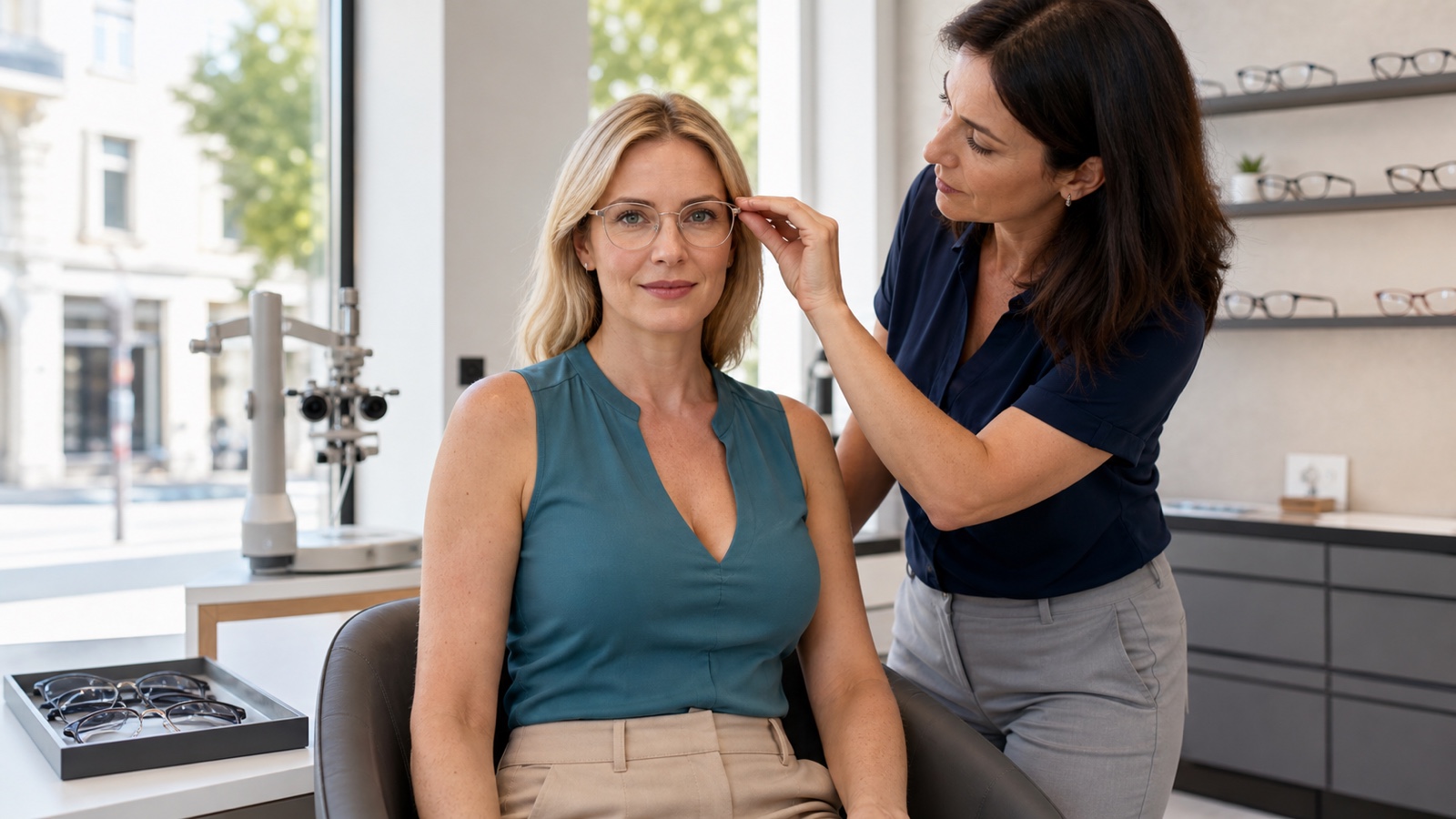
Blurred text, dry eyes or headaches after several hours at a screen are not just annoying. They can indicate that vision, working distance and screen setup are not working well together. In Austria, people who regularly work at a computer are entitled, under certain conditions, to an eye exam and—if normal corrective lenses are not sufficient for the specific working distance—to a special workplace screen glasses. In principle, the employer must cover the necessary costs.
However, any arbitrary new everyday glasses do not automatically become a company benefit. For a screen glasses paid for by the employer in Austria the actual screen work, a professional examination, the medical necessity and a properly coordinated procurement route count. This guide explains the rules, shows the practical procedure and helps avoid unnecessary arguments about frames, lenses and invoices. It does not replace medical or individual legal advice.
What distinguishes a workplace screen glasses from a normal pair of glasses
A workplace screen glasses is a special visual aid for the distance between the eyes, the monitor and working documents. This distance often lies between classic reading distance and distance vision. The Chamber of Labour brochure on screen work names a typical screen distance of about 60 to 90 centimetres. A normal reading glass is usually designed for shorter distances. An ordinary progressive (multifocal) lens can in turn cause employees to raise their heads or search in a narrow zone for the correct focus.
The Austrian Screen Work Regulation in § 12 requires that the special visual aid be tailored to the working distance, physiological conditions and findings. The lenses must be anti-reflective and must not be tinted. Depending on the activity, single-vision or suitable multifocal lenses may be appropriate.
So the decisive factor is not the sales description in the optician's shop, but the proven need at the specific workplace. A fashionable blue-light filter glasses without the appropriate vision correction is not automatically a workplace screen glasses in the legal sense. Conversely, a professionally prescribed workplace glasses can be necessary even if someone already wears another pair of glasses or contact lenses in everyday life.
Who in Austria may be entitled
The special protection rules apply when a non-negligible share of daily work takes place at a screen. The Labour Inspectorate on screen workstations cites more than three hours of screen work per day or more than two hours of uninterrupted screen work as criteria. It's about the actual activity and not just whether a monitor is present in the office.
Someone who only occasionally checks data briefly is not automatically subject to the same requirements. Those who, by contrast, handle e‑mails daily, plan, program, book, design or manage customer data often reach the threshold quickly. Part-time employees can also be eligible. The Chamber of Labour Upper Austria explicitly clarifies that entitlement is not tied to full-time employment; the decisive factor remains the screen exposure.
However, the right to a special visual aid does not arise solely from many hours at the screen. First, an examination must show that a workplace screen glasses is necessary because normal corrective aids cannot be used for the required working distance. If a person sees without complaint and sufficiently with the existing correction at the workplace, they do not automatically receive an additional pair of glasses.
What applies in the home office
Screen work does not legally disappear just because it takes place in a private apartment. The Labour Inspectorate classifies telework and home office as external workplaces. Employees remain employees within the meaning of occupational safety if the conditions are met. Screen duration, complaints and the necessary examination should therefore also be addressed in the case of regular telework.
Practically, the working distance at home is particularly important. Anyone who alternates between a large office monitor, a small laptop and a private secondary screen should state these distances during the examination. The glasses must match actual use. The jobspot.at guide on telework in Austria.
What eye examination must be offered
For relevant screen work, the employer must offer an appropriate examination of the eyes and visual ability:
- before starting screen activities,
- then at intervals of three years and
- additionally, if visual complaints occur that may be related to screen work.
According to the legal provisions, the examination can, among others, be carried out by ophthalmologists, occupational or company medicine specialists and similarly qualified persons. If an abnormal or medically clarifying finding emerges, the route leads to the ophthalmologist's practice.
The employer must not only enable the necessary examination. According to the Chamber of Labour, the necessary time off and continued payment of wages must also be taken into account. Employees should therefore not treat the appointment as a private doctor's visit without coordination, but should first ask about the company procedure.
When the employer must pay for the screen glasses
§ 12 of the Screen Work Regulation provides that employers bear the costs of special visual aids, provided these are not covered by a social insurance carrier. Covered is the extent necessary under occupational safety law. This includes the suitable lenses, the necessary anti-reflective coating and a usable frame.
The Chamber of Labour Upper Austria on screen glasses points out that there is no legally defined flat maximum price. An internal company rule may not reduce the necessary protection to an arbitrary amount. But that does not mean every designer frame and every additional coating must be paid for. If an employee voluntarily chooses a more expensive option that goes beyond what is medically and functionally necessary, the difference can remain their personal expense.
For that reason, the order of steps is more important than the purchase price: determine the need, inform the employer, agree on the cost estimate and only then order. Someone who buys an expensive pair of glasses without consultation may well have a legitimate need, but creates avoidable points of dispute about provider, equipment and invoicing.
Necessary benefit or private upgrade?
| Item | Typical classification | What to clarify in advance |
|---|---|---|
| Lenses for screen and document distance | Central component if necessity is confirmed | Regulation and concrete working distances |
| Anti-reflective coating | Explicitly required by the regulation | What lens quality is necessary |
| Suitable standard frame | Required for a usable visual aid | Company partner optician or frame |
| Expensive brand or designer frame | Extra cost can remain private | Difference to the necessary frame |
| Blue-light filter and comfort coatings | Not automatically legally required | Medical or work-related justification |
| Tinted lenses | Not provided for the workplace screen glasses according to the regulation | Not to be ordered as the standard solution |
In seven steps to the right screen glasses
1. Record screen time and complaints concretely
Note for one week how many hours you actually work at the monitor, whether there are longer uninterrupted phases and during which tasks complaints occur. Also document monitor distance, laptop use and gaze switches to paper documents. This does not replace an examination but makes the conversation more concrete.
2. Ask about the company regulation
Ask HR, your manager, occupational health or the works council whether there is a company agreement, a form, a partner optician or guidelines for cost estimates. A neutral inquiry is sufficient:
I regularly work several hours at a screen and experience visual complaints. Please inform me about the company procedure for an eye examination and, if necessary, a workplace screen glasses.
3. Arrange the examination
Use the offered examination route. Bring any existing glasses and the most important working distances. Do not describe only "computer work", but also whether you switch between two monitors, paper, customers or devices.
4. Have necessity and specifications documented
The report should show that a special visual aid for screen work is needed. For the order, working distance, lens type and required properties are decisive. Medical details do not have to be passed unfiltered to the manager; for cost processing it is sufficient to provide the required information about need and specifications.
5. Submit a cost estimate
Have the necessary standard specification itemized and separate voluntary extras. That way it is clear which amount the employer must cover and which private surcharge may apply. Also clarify to whom the invoice must be issued.
6. Order only after approval
A short written confirmation protects both sides. If the company specifies a partner optician, that optician should actually be able to provide the prescribed specification. The cheapest solution is not sufficient if the necessary wide field of view or required strength is missing.
7. Hand in invoice and documents in an orderly way
Submit the invoice, approval and the required evidence according to the agreed procedure. Keep copies. In case of later adjustments or a workplace change it will be traceable for which distance the glasses were made.
Why a screen glasses alone does not solve the problem
A suitable visual aid corrects vision, but does not replace a good screen workstation. Too small text, glare, a laptop placed too close, dry air or hours of unvaried posture can continue to exacerbate complaints. The Labour Inspectorate recommends, among other things, a sensible maximum screen distance, appropriate font size, a low-reflection setup and regular gaze changes.
For more than 50 minutes of uninterrupted screen work, a ten‑minute break from screen activity or a corresponding change of activity must generally be organised. This does not have to be a rest break: a phone call without a monitor, a face‑to‑face conversation or another task can relieve the eyes. The existing jobspot.at guide on working time recording and breaks explains why such times should be clearly regulated organisationally.
In addition, an ergonomic sitting position, changing posture and sensible lighting help. A broader overview is provided by the article Promoting ergonomics in the workplace.
What to do if the employer refuses to cover the costs?
First, it should be clarified exactly what the disagreement is about. Often it is not about the entitlement itself, but about missing approval, an insufficiently documented necessity, the chosen frame or voluntary additional services. Ask for a written justification and present the report, cost estimate and company correspondence in an orderly way.
If the refusal persists, the works council, safety representative, occupational health service, Chamber of Labour or union are sensible contacts. Do not hastily buy a second pair of glasses and do not carry out a fundamental discussion only orally. A factual documentation makes it easier to examine whether the conditions were met and which share of costs was necessary.
Three typical practical cases
Case 1: Part-time employee with long screen blocks
A clerical worker works 25 hours per week. On four days she spends more than three hours at the monitor each and often processes data sets for more than two hours without other tasks. After increasing headaches she asks HR about the examination route. The examination confirms that her everyday glasses are not sufficient for the medium screen distance. Despite part-time work, a necessary workplace screen glasses can be claimed because the concrete screen work and the confirmed need count.
Case 2: Different distances in the home office
A project manager regularly works two days at home. At the company he uses two large monitors, at home a laptop with an additional screen. He brings the measured distances of both workplaces to the examination. Instead of ordering a pair of glasses only for the near laptop, a version for the actually recurring distances is determined. Before ordering, he coordinates the specification and cost estimate with the employer. This way the glasses remain usable at both workplaces and the cost decision is comprehensible.
Case 3: Necessary lenses plus voluntary designer frame
An employee needs special multifocal lenses with a wide range for monitor and documents. The cost estimate includes a suitable standard frame and a significantly more expensive designer frame. The employer covers the necessary lenses, anti-reflective coating and the amount for the suitable frame. The employee voluntarily chooses the designer model and pays only the clearly itemised difference herself. By separating the items, no dispute arises about which part serves occupational safety.
Frequently asked questions about screen glasses
Do I automatically get a new pair of glasses every three years?
No. The three‑year interval refers to the offer of an eye and vision examination. A new pair of glasses again requires a corresponding need.
Is a normal reading glass sufficient?
Only if it is suitable for the specific working distance. Screen, documents and keyboard are often further away than a book. Whether an existing pair is sufficient must be professionally assessed.
Does the entitlement also apply in part-time?
Yes, part-time employment does not exclude it. Decisive are screen duration and confirmed necessity, not just the agreed weekly hours.
Does the employer have to pay for a luxury frame?
They must finance what is necessary. For a voluntarily chosen surplus without medical or functional necessity, the employee may have to pay themselves.
Can I simply buy the glasses and submit the invoice?
This is not recommended. Examination, proof, company procedure and cost estimate should be clarified before ordering. That prevents disputes about necessity and equipment.
Does a blue-light filter glasses from retail count?
Not automatically. The decisive factor is a special visual aid tailored to the individual working distance. A marketed filter alone does not replace an examination or confirmed necessity.
Conclusion: Clarify the need first, then buy
Anyone who regularly works at a screen should not compensate for visual complaints by always increasing the font size or moving the monitor closer. In Austria, for relevant screen work there are concrete rights to an examination and, if necessary, to a suitable workplace screen glasses. In principle, the employer bears the necessary costs.
The safest route is clear: record screen exposure, ask about the company procedure, use the examination, document the need and agree the cost estimate before ordering. Check your actual monitor distance today and ask in writing about the intended examination route if you have complaints. That turns a vague wish into a comprehensible occupational safety case.
Sources and further information
- Labour Inspectorate: screen workstations, breaks, eye examinations and visual aids
- Legal information system: § 12 Screen Work Regulation
- Chamber of Labour Upper Austria: screen glasses and cost coverage
- Chamber of Labour Vienna: screen work and workplace screen glasses
- Central Labour Inspectorate: cost bearing for workplace screen glasses