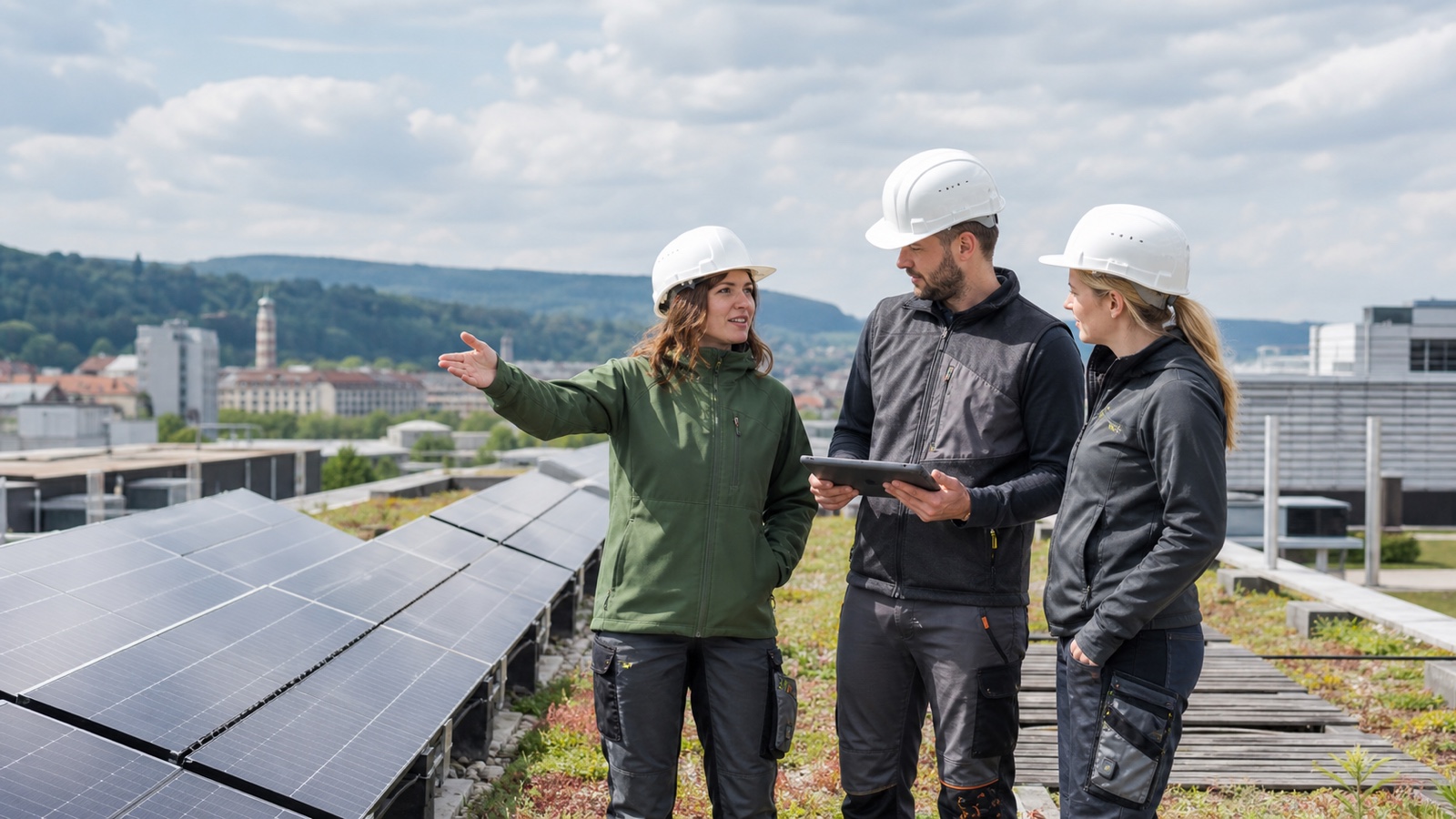
Green jobs are no longer a niche topic in Austria. Anyone looking for professional prospects today will find climate-relevant tasks not only in classic environmental professions, but also in electrical engineering, construction, renovation, public transport, logistics, IT, energy consulting, recycling, agriculture, and many technical service sectors. This is exactly what makes the topic interesting for job seekers: entering the field does not necessarily require a new degree or a complete career change. Often, it is enough to combine existing experience with relevant green skills.
The current labor market is demanding at the same time. According to the AMS, 301,676 people were registered as unemployed in Austria in May 2026; the national unemployment rate was 7.1 percent. At the same time, there were 79,116 immediately available job vacancies at the AMS. Statistics Austria reported a total of 133,100 job vacancies for the first quarter of 2026 in its job vacancy survey. For applicants, this means: there are opportunities, but the fit between qualifications, industry, and the specific job advertisement counts for more than in boom phases.
Green jobs are a particularly exciting search field because they apply to many industries that Austria needs for the energy transition, building renovation, resource efficiency, and climate-friendly mobility. The Ministry of Social Affairs and the AMS report green jobs monthly as climate-relevant professions. According to the BMASGPK/AMS, open green job positions account for around 15 to 17 percent of all open AMS positions over the annual cycle. Anyone reorienting their career should therefore not view this group as a special market, but as a cross-section of many very normal career paths.
What counts as a green job in Austria
For the AMS and the Ministry of Social Affairs, green jobs are professions that can avoid environmental damage and preserve natural resources. These include, on the one hand, green jobs in the narrower sense, where the environmental connection is directly in the job profile, such as waste management and recycling specialists or energy technicians for renewable energies. On the other hand, they also include professions that can become climate-relevant through additional qualifications, such as electricians with photovoltaic know-how or automotive body technicians with recycling and disposal knowledge.
This broad definition is important because it opens many doors. Green jobs do not automatically mean: a completely new profession, a green start-up scene, or an academic environmental career. Traditional apprenticeships and skilled trades can also become green if they are needed for renovation, energy efficiency, the circular economy, or climate-friendly infrastructure. The current BMASGPK/AMS professional list includes 536 professions, including 190 green jobs in the narrower sense and 126 green apprenticeship professions.
This also explains why the topic is relevant for very different target groups. Career starters can consider green jobs when looking for an apprenticeship or training. Employees with practical experience in construction, installation technology, transport, or production can specialize through additional qualifications. People with a commercial or administrative background can score points in sustainability-related roles if they bring industry understanding, project organization, and data competence.
Where the opportunities are currently most visible
The labor market for green jobs is not the same in every area. According to the Ministry of Social Affairs, the number of job seekers fluctuates throughout the year: it is higher in winter, while in spring and summer it approaches a tighter ratio between unemployed people and open AMS positions. This is plausible because construction, renovation, installation, agriculture, transport, and certain technical projects have seasonal dynamics.
Opportunities are particularly tangible where climate goals must be translated into concrete work. Buildings must be renovated, heating systems replaced, PV systems planned and installed, grids upgraded, vehicles maintained, resource flows documented, and processes made more efficient. The WKO describes green skills as the ability to realign products, services, or processes for a climate-neutral economy. Traditional professions such as electrician, roofer, or plumber are specifically mentioned here.
Statistics Austria also shows that the environmental economy is already a significant employment factor. In the preliminary results for 2024, 231,097 environmental employees were reported. Environmentally oriented gross value added was 23.7 billion euros, and environmental exports were 18.1 billion euros. Although the values were lower than in 2023, the level remained high. For job seekers, this is an important indication: sustainability is not just a communication topic, but stands for real value creation and real work in Austria.
Green Skills: These competencies make applications stronger
Anyone applying for green jobs should not just write the word sustainability in their CV. What is decisive is which concrete skill fits the job. For technical roles, this can be knowledge in electrical engineering, building services, energy efficiency, photovoltaics, heat pumps, measurement and control technology, recycling processes, materials science, or quality assurance. In the construction and renovation sector, understanding of building physics, insulation, moisture protection, tendering practice, project coordination, and construction site experience are among the factors that count.
In commercial, organizational, and digital roles, other green skills are in demand. These include data analysis, reporting, supply chain understanding, ESG basics, process optimization, funding logic, procurement, documentation, and customer consulting. IT and digitalization skills can also have a green effect if they reduce energy consumption, make maintenance more predictive, or make material and transport routes easier to plan.
A good application text therefore translates experience into impact. Instead of writing generally: "I am interested in sustainability," it is more concrete to say: "I documented material consumption in work preparation and reduced waste," "I was responsible for the scheduling of renovation projects," or "I advised customers on energy-efficient solutions." Green jobs are often practical transformation jobs. Employers are not just looking for an attitude, but for reliable evidence that someone can solve problems.
How job seekers can search for green jobs more specifically
The AMS marks job offers in "alle jobs" that are assigned to a green job classification. This is helpful, but it does not replace your own research. Many suitable jobs do not necessarily have "Green Job" in the title. Anyone who only searches for this term easily overlooks installation, construction, logistics, technical, data, or project roles that are climate-relevant.
A combined search strategy makes sense. In addition to "Green Jobs Austria," applicants should use concrete professional and skill terms: photovoltaics, building services, energy consulting, renovation, recycling, waste management, circular economy, electrical engineering, public transport, environmental management, ESG, sustainability report, energy efficiency, heat pump, or mobility. Regional combinations can also help, such as "Green Jobs Vienna," "Renovation Lower Austria," "Photovoltaics Styria," or "Energy Consulting Upper Austria."
Those who are just starting out should also check the professional lexicon, AMS information, and further training opportunities. The comparison with existing jobspot topics is also interesting: for example, those planning longer further training will find information on funding and planning issues in the article on Further education time. Anyone who wants to know how shortage occupations generally work can consult the overview on shortage occupations. For young people, the question of which green apprenticeship professions offer realistic entry points also remains important; the jobspot article on apprenticeships.
Application: Showing sustainability credibly
In green jobs, it is rarely enough to justify motivation only morally. Companies want to know whether the applicant understands the task. The cover letter should therefore combine three levels: interest in the specific company, relevant professional experience, and a comprehensible contribution to the task.
An example: For a position in energy consulting, it is stronger to mention concrete consulting, technical, or customer experience than to refer generally to climate protection. For a project role in building renovation, scheduling, interface work, contact with authorities, supplier coordination, or cost awareness count. For a logistics role with a sustainability focus, route planning, fleet knowledge, data maintenance, or experience with process improvements are relevant.
The CV should also be sorted accordingly. Under each position, two to three bullet points can show which tasks fit the target role. Anyone who has not previously worked in a green industry can highlight transferable experience: technical accuracy, customer contact, occupational safety, project planning, documentation, quality management, team leadership, or digital tools. The clearer the transfer, the lower the risk of a career change appears.
Career change: When further training makes sense
Not every green job application needs a long certificate in advance. For many roles, practical experience is decisive. Further training is particularly worthwhile if it closes a concrete gap: for example, basics of electrical engineering, PV installation, energy certificate, CAD, building services, waste law, sustainability reporting, project management, or data analysis.
Before making a course decision, job seekers should compare five to ten concrete advertisements. Which requirements are repeated? Which of these are must-have criteria, which are only part of the desired profile? Which terms appear in different companies? This results in a much better further training decision than a general feeling of a trend. Anyone already registered with the AMS should clarify qualification opportunities and eligibility for funding with their responsible consultant at an early stage.
This also results in a learning for employers. Green recruiting becomes stronger when advertisements do not just describe big sustainability goals, but show the actual tasks and learning paths. If a company can train career changers, this should be explicitly stated in the advertisement. Especially with climate-relevant professions, potential is more important than the perfect CV template.
Conclusion: Approach green jobs realistically but offensively
Green jobs offer real opportunities in Austria, but they are not an automatic job guarantee. The market is broad, the requirements differ greatly, and many positions are not recognizable as green at first glance. Anyone who wants to search successfully therefore needs a precise search strategy, clear skill terms, and application documents that translate experience into concrete impact.
The best next step is pragmatic: select three suitable professional fields, compare current advertisements, note recurring competencies, and sharpen your CV accordingly. Only then decide whether further training is necessary. This is how the buzzword green jobs becomes a concrete career plan for the Austrian labor market.
Sources
- Ministry of Social Affairs: Overview of green jobs in the Austrian labor market
- AMS: Green jobs and labeling in "alle jobs"
- Statistics Austria: Environmentally oriented production and services
- AMS: Overview of the labor market, May 2026
- Statistics Austria: Job vacancies, 1st quarter 2026
- WKO: Green Skills