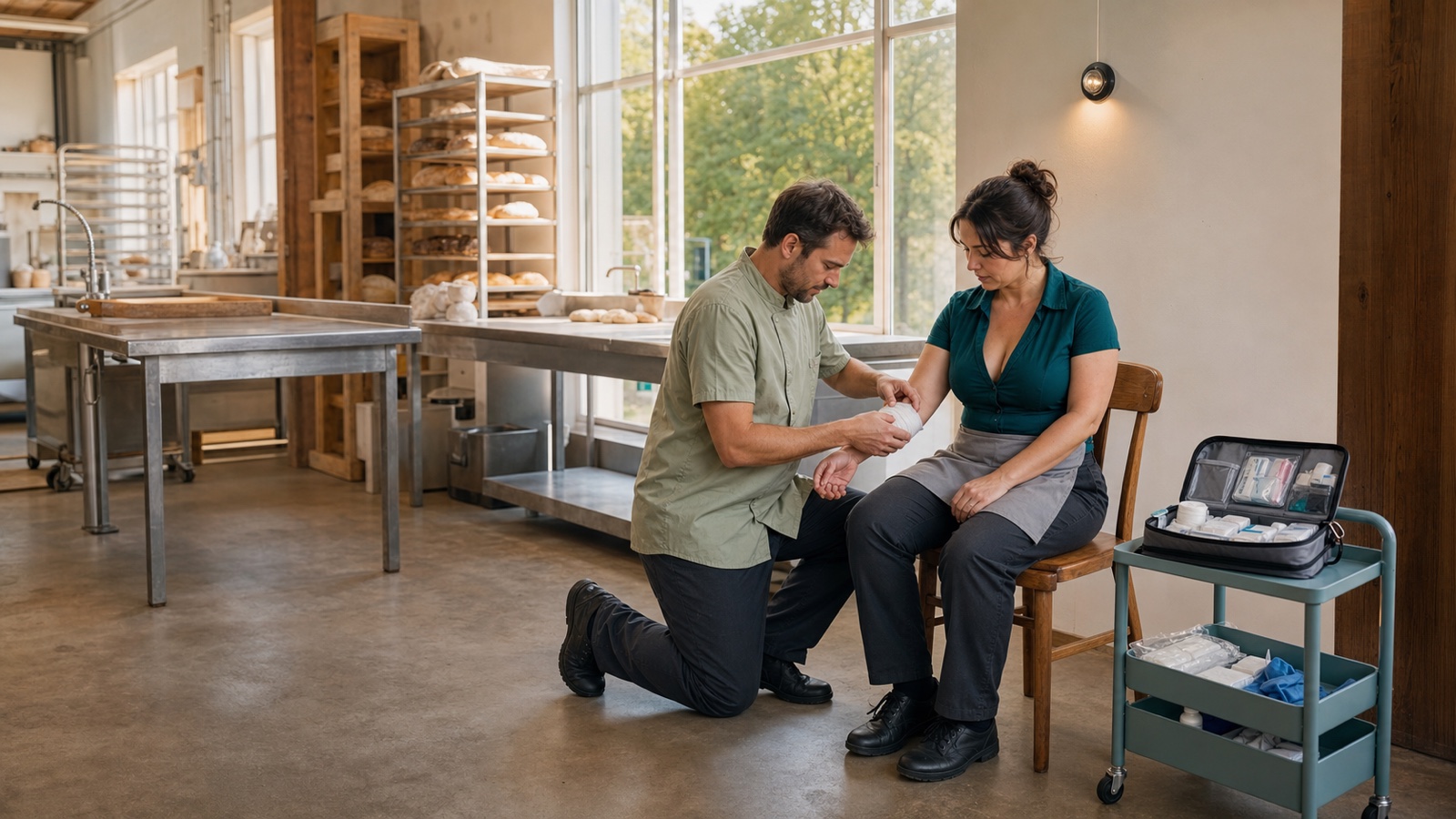
After a work accident, health comes first. Secure the hazard area, provide first aid and, if necessary, call emergency services or the police: this sequence is more important than any form. Once the acute situation is under control, however, a second phase begins that can be decisive later. The accident must be reported, described in a verifiable way, and medically correctly classified.
Documentation is often postponed, especially with seemingly minor injuries. However, symptoms can worsen only hours or days later. It then needs to be possible to see when, where and during which activity the accident occurred. This checklist explains how employees can report a report a workplace accident in Austria, which deadlines apply to the company and how commuting accidents, telework and sick leave are distinguished from each other.
What takes priority in the first minutes
The correct response depends on the severity of the accident. No one should move an injured person if doing so could create additional danger. Machines and energy sources may only be shut down by authorized personnel. In cases of fire, electricity, chemicals, traffic or unstable structures, self-protection must also be observed.
The four-step sequence
- Stop the danger or secure the area: Warn others and create safe distances.
- Organize first aid: Notify a first aider and use existing emergency procedures.
- Call professional help: For serious injuries, unconsciousness, heavy bleeding, breathing problems or an unclear situation, call the emergency number immediately.
- Inform supervisors: Report the accident immediately to the responsible manager or company reporting office.
The report must not delay care. Conversely, an injury that has received medical treatment should not be treated as a private matter just because it initially seems minor.
What can legally count as a work accident
A work accident is connected spatially, temporally and causally to the insured activity. Typical examples are an injury while operating a machine, carrying a load, on a business trip, or during an activity initiated by the company. The current overview from oesterreich.gv.at on work accidentsalso describes equivalent incidents and the responsible accident insurance providers.
Whether an event is recognized is ultimately decided by the responsible accident insurance provider based on the concrete circumstances. Employees do not have to make this legal classification conclusively at the accident scene. They should report the actual sequence of events in full and not sugarcoat anything as 'private' or 'company-related'.
Distinguishing work accident, near-miss and hazard
- Work accident: An insured person is injured during an activity related to the company.
- Near miss: The event could have led to an injury but turned out unharmed.
- Serious immediate danger: A condition threatens safety or health, even if nothing has happened yet.
- Defect in a protective system: A safeguard, interlock or protective device is not functioning properly.
According to the legal guidance of the Labour Inspectorate employees must report all four situations immediately to the responsible supervisor or other responsible persons. A near miss is therefore not an insignificant incident but an opportunity to prevent the next actual accident.
Who must report the accident to whom
Employees report internally immediately
The employee informs the employer, the manager or the designated reporting office without delay. A brief written confirmation after the verbal alert is advisable as soon as the health situation allows. This should initially include the date, time, location, activity, injury and people involved.
The works council, the safety representative or the safety specialist can additionally be important points of contact. However, they do not replace the report to the employer.
The employer reports to the accident insurance
After § 363 ASVG the employer must report every work accident to the competent accident insurance provider, in which an insured person is killed or is wholly or partially unable to work for more than three days, no later than within five days. This is often the AUVA; depending on the employment, BVAEB or other providers may also be responsible.
The AUVA provides the accident report electronically available. For secure transmission, email with TAN confirmation or ID Austria are envisaged. The reporting threshold does not mean that shorter or initially consequence-free events should be forgotten. They should be documented internally, especially if late effects seem possible.
Serious and fatal accidents require an immediate report
Serious or fatal work accidents must be reported by the employer immediately to the competent labour inspectorate, unless the police have already been notified. The report to the police or labour inspectorate and the report to the accident insurance provider serve different purposes. In a serious situation, the company's emergency plan should specify clear responsibilities.
Understanding the five-day deadline correctly
The statutory deadline is aimed at employers and other entities required to report. No waiting period for employees can be derived from this. They must report the accident internally immediately. Only later may it become apparent that the inability to work lasts longer and thus a report to the accident insurance provider is required.
Practically, this means: a company should record the case from the outset and monitor any further sick leave. Anyone who is injured should ask whether the accident report has been sent and request a copy or confirmation. The Arbeiterkammer explicitly recommends, to ensure that the employer, physician or hospital have initiated the report to AUVA.
What employees should document
Good documentation is factual. It describes observations and separates them from assumptions. Blaming others seldom helps in the first hours and can obscure important details.
The evidence-preservation checklist
- Date and, if possible, exact time
- Work location and precise spot of the incident
- Activity performed and assignment
- Sequence of events in chronological order
- Machine, tool, vehicle or work substance used
- Safety measures and personal protective equipment worn
- Names and contact details of witnesses
- Visible injuries and initial complaints
- First aid provided and authorities notified
- Photos of the situation, if safe, permitted and possible without disrupting aid
- Medical findings, sick note, prescriptions and travel receipts
- Copy or identification number of the accident report
Documents should not be stored only on a company device that may be inaccessible during a longer sick leave. Confidential company data must nevertheless not be copied or published without authorization. A personal factual note and one’s own medical records are often sufficient for private storage.
Clearly state the work relation to the doctor
The doctor or hospital must know that the injury occurred at work or on an insured route. Describe the mechanism: fall from what height, cut by which tool, twist under which load or impact from which direction. This can be relevant for diagnosis, findings and later assessment.
Sick leave and an accident report are two different processes. The inability to work is medically certified and reported according to company rules. In addition, the accident itself must be documented. The jobspot.at guide reporting sick leave explains the general steps towards the employer.
If the employer does not report
Employees should first inquire in writing and refer to the facts already reported. If the report is not made or the work-related connection is disputed, prompt advice is advisable. The Arbeiterkammer on accident insurance advises those affected to submit an accident report to AUVA or BVAEB themselves in a timely manner if the employer has not done so.
A chronological presentation, medical records, witness contacts and previous communication help with this. The report does not automatically decide recognition or a specific benefit. However, it ensures that the accident insurance provider can examine the case.
Commuting accident: The direct connection must be identifiable
Accidents on the direct route to or from work can also be insured. The current overview of traffic accidents as work accidents also lists certain routes to lunch, to vocational training, to a scheduled doctor's appointment, as well as to the care or school of a child under supervision.
Private detours and longer interruptions can change the connection. Therefore, employees should secure the route, destination, departure time, traffic conditions, police details, photos and witnesses. In the case of a traffic accident, the usual obligations and insurance issues of road traffic are added to the company report.
Case study: Fall on the way home
An employee falls off his bicycle on the usual direct route from the workplace to his home. After medical care he immediately informs the employer, documents the location and time and cites the journey home as the connection. A short shop on a much more distant route, by contrast, would need to be explained separately and could change the assessment.
Work accident during telework
Legal accident insurance coverage can also exist for telework. The decisive factor is whether the event is related to the insured work. In a private setting the distinction is more difficult because professional and private activities are close to each other in space.
The AUVA explains insurance coverage for telework including certain routes to agreed telework locations. Employees should precisely document the work assignment, time, specific activity and accident site. A fall while fetching work-related documents can be judged differently than an injury during a purely private household task.
Case study: Injury in the home office
An employee trips over the power cable of the company-used laptop during a work video meeting. She secures the time via the calendar entry, photographs the situation and reports the sequence. The decisive factor is the traceable work activity, not merely the fact that the accident happened in the apartment.
What the company must check after the accident
An accident report is not a final report. According to the Labour Inspectorate, employers must review and, if necessary, adjust the risk assessment after work accidents. A renewed instruction may also be necessary. Records of fatal accidents and accidents with more than three calendar days of work absence must be kept for at least five years.
A useful root-cause analysis does not only ask who acted last. It examines work preparation, time pressure, qualification, maintenance, safety systems, traffic routes, communication and organization. A broader overview of prevention is offered by the jobspot.at article Occupational safety: Rights and duties.
Eight steps after a work accident
- Protect health, provide first aid and call emergency services if necessary.
- Have the hazard area secured and prevent further accidents.
- Inform the employer or responsible manager immediately.
- Record sequence, location, time, witnesses and initial complaints factually.
- Explicitly state the work or commuting relation to the doctor or hospital.
- Report sick leave according to company rules.
- Ask whether the accident report has been sent to the responsible provider and secure confirmation.
- In case of problems or late effects, contact AUVA, BVAEB, Arbeiterkammer, the union or works council early.
Three mistakes that cause problems later
"It was only a minor thing"
A minor bruise or a brief dizziness can become worse later. A short report and a factual note are not a drama but create clarity.
Confusing sick leave with an accident report
Information about inability to work does not automatically replace the reporting of the work accident. Both processes should be explicitly addressed.
Only tell it verbally
Memories change, shifts change and witnesses are harder to reach later. A timely written summary reduces misunderstandings.
FAQ on work accidents
Does every minor work accident have to be reported to AUVA?
The statutory employer report under § 363 ASVG applies in cases of death or more than three days of complete or partial incapacity to work. Employees must nevertheless report every work accident internally immediately. In cases of unclear late effects, further documentation or advice may be advisable.
Who decides whether it really was a work accident?
The responsible accident insurance provider examines the connection and decides on recognition and benefits. Employers or employees should present the actual sequence of events in full, rather than pre-empting the decision.
Does an accident during a break count as a work accident?
That depends on location, activity and context. The route to a usual meal may be protected under certain conditions; purely private activities may be judged differently. If in doubt, the case should be reported and examined individually.
What happens with long-term consequences of an accident?
Statutory accident insurance can provide medical treatment for accidents, rehabilitation and further benefits depending on the recognized case. For returning after a longer incapacity to work, an agreed solution may also be necessary. The jobspot.at guide to Reintegration part-time explains the basic structure for this.
Conclusion: Help first, then record everything completely
After a work accident, no form should displace first aid. Once the situation is safe, employees should inform the employer immediately, document the sequence of events and state the work relation during medical treatment. Afterwards, it should be checked whether the report has been sent to the competent accident insurance provider.
Factual documentation not only protects possible claims. It also helps the company to identify causes and prevent the same accident in the future. Save the eight-step checklist where you can reach it in an emergency, and clarify in advance within the team who will handle first aid, internal reporting and authorities contacts.
Sources
- oesterreich.gv.at: Work accident and equivalent incident
- Labour Inspectorate: Legal obligations after work accidents
- RIS: § 363 ASVG on accident reporting
- AUVA: Insurance coverage and reporting obligation
- Arbeiterkammer: Work accident as an employee
- Arbeiterkammer: Benefits and proof in accident insurance