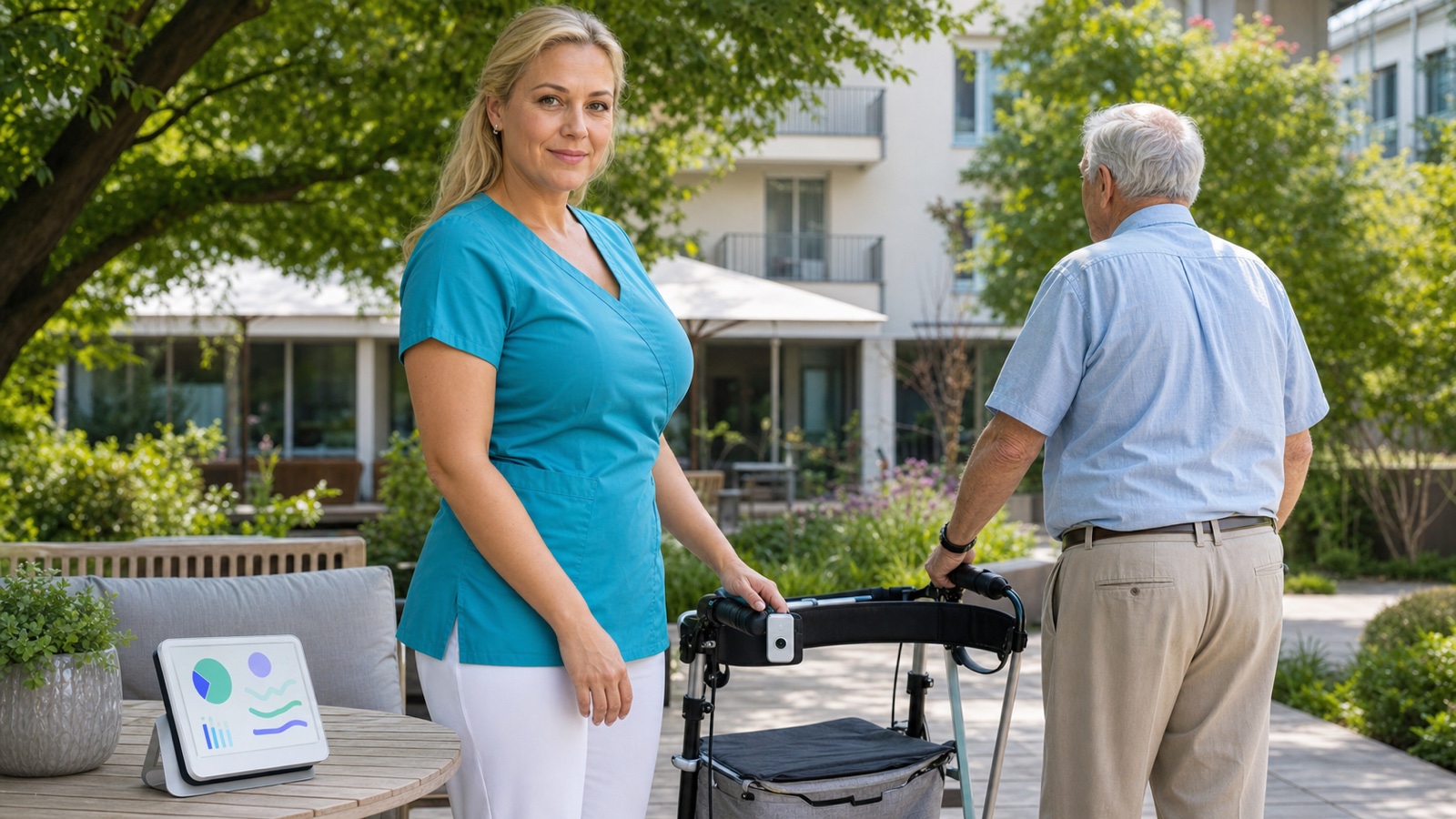
Care workers document, plan, observe, coordinate and continuously make decisions under time pressure. It is precisely at these interfaces that artificial intelligence appears: it can structure texts, detect patterns in data, prioritize alerts or assist with scheduling. But in care, a plausibly sounding suggestion is by no means a reliable recommendation for action.
AI in careTherefore it should not be measured by how many tasks a system automates. Crucial is whether it demonstrably creates time for care, does not conceal errors, protects health data and clearly leaves professional responsibility with qualified people. This guide clarifies which applications are realistic, which competencies employees in Austria need and which questions teams should clarify before any introduction.
Why the topic is especially important for Austria
The need for personnel in care remains high. The current AMS JobBarometer on nursing assistance rates the job prospects in Austria as very good and records 27,205 online ads in 2025 for the professional group of health and nursing care as well as midwives. For nursing assistants, IT application skills have gained significantly in importance when comparing the periods 2022/23 and 2024/25.
That does not mean that AI solves the skilled labor shortage. But it shows that digital tools are reaching an area where time, staff and attention are scarce. For career entrants, expertise, communication and teamwork remain central. An overview of training and entry is provided by our guide to Care jobs in Austria.
Internationally, the development is also becoming more concrete. A report published in April 2026 WHO report on AI in healthcare in EU member states emphasizes three prerequisites: the competencies of staff, transparent involvement of healthcare professionals and patients, and secure governance. Innovation alone is not enough.
AI is not all the same: three levels of application to distinguish
In everyday professional life, very different systems are grouped under the term AI. For a fair assessment teams should separate at least three levels.
1. Administrative assistance
These include systems that generate drafts for handovers, internal summaries or standardized texts from released information. They can reduce search effort and standardize wording. The professional content must be fully checked before adoption. A linguistically neat documentation can still be factually incorrect or incomplete.
2. Pattern recognition and alerts
Such systems analyze measurements or documented observations and flag anomalies, for example possible changes in a risk profile. However, a flag is not a diagnosis. Crucial is whether the system has been tested and approved for the specific purpose, which data may be missing and who assesses an alert.
3. Clinical decision support
The closer an application gets to diagnosis, therapy or patient safety, the higher the requirements. The European Commission on AI in healthcare points out that AI-based software for medical purposes can be classified as a high-risk system. Risk management, data quality, clear information and human oversight are then not optional extras.
The classification depends on the intended purpose of the specific product. Employees should not derive it from a marketing brochure, but should have the employer explain what the system is approved for and which rules apply.
Where AI can usefully support everyday care
Prepare documentation, don't invent it
An approved application can convert structured inputs into a readable draft, mark duplicate entries or show missing mandatory fields. This can help when documentation is technically cumbersome. The caregiver must still check whether observation, time, measure and effect are correctly represented.
An automatic completion that adds unmeasured values or unobserved symptoms would be particularly risky. A good solution therefore clearly labels what comes from existing data, what was suggested and who confirmed the final version.
Make information findable more quickly
An internal search system can make released standards, hygiene requirements or process descriptions more quickly accessible. The benefit does not come from a general answer machine, but from a limited, maintained knowledge base with versions, responsibilities and update dates.
Ease planning and coordination
AI can make suggestions for routes, appointments or resources. In mobile care, distances, time windows and qualification requirements could be taken into account. However, a computationally efficient plan can be unreasonable if breaks, continuity of relationships, language skills or the real care time are missing. Therefore every suggestion needs professional and work-organizational review.
Provide early warnings
Sensors and analysis systems can report changes, for example in movement or recurring measurements. This can direct attention, but does not replace direct observation and conversation. False-positive alerts increase the burden; overlooked changes can create false security. Teams therefore need clear thresholds, escalation paths and ongoing quality control.
What AI cannot take over
Care is not just data points. Pain, fear, orientation, shame, family dynamics and small changes in behaviour are often only understood in contact. A caregiver connects observation, biography, environment, expertise and the current situation. This contextual work cannot be reduced to a score.
Legal tasks also remain tied to qualifications and professional law. The Austrian health portal on care professions distinguishes nursing assistance, nursing specialist assistance and the higher service, each with defined competencies and areas of responsibility. An AI suggestion does not expand these authorizations.
This means in practice:
- A nursing assistant must not make a decision outside their area of responsibility just because a system recommends it.
- A registered nurse remains responsible for the professional assessment within their own area of competence.
- Unclear or contradictory outputs must be escalated, not silently adopted.
- A system must not displace human care as an allegedly inefficient activity.
Health data do not belong in private AI tools
Health data are particularly protected. The Austrian Data Protection Authority on AI and data protection explicitly names health data as a special category of personal data. Omitting names is not always enough: age, a rare diagnosis, location, time or particular circumstances can indirectly identify a person.
Therefore there is a simple rule in everyday care: do not enter patient data, photos, findings, audio recordings, duty rosters or internal documents into publicly accessible AI services unless there is an expressly approved company solution and legal basis for it. A private account or one's own smartphone does not make the use harmless.
The Chamber of Labour on AI in the workplace recommends adhering to internal rules and not entering confidential or personal data into online AI tools. Employers may prohibit the use of certain services. Where rules are lacking, employees should not experiment on their own but should request clarification via management, the data protection officer or the works council.
Human control must work in practice
"Human in the loop" sounds reassuring, but it only makes sense if the person monitoring has sufficient time, competence and scope to make decisions.Article 14 of the EU AI Act requires effective human oversight for high-risk systems. Humans should be able to understand outputs, monitor them, ignore or override them if necessary, and be aware of the danger of excessive trust.
This raises concrete questions for care facilities:
- Who is responsible for checking an output?
- What qualification does this person need?
- Is it clear which data the suggestion is based on?
- How is an incorrect output corrected and documented?
- Can the system be overridden without disadvantage for staff?
- What happens in case of failure, poor data quality, or unusual cases?
If only seconds are available for checking during a hectic shift, human oversight may be merely formal. Then the process must be changed, not quietly shifted the responsibility onto the individual caregiver.
What competencies care workers now need
No one in a care profession needs to become a data scientist or programmer. What is necessary is application-related AI competence that directly fits the workplace.
Be able to explain the purpose of the system
Employees should know which problem is to be solved, which inputs are processed and what the output means. Someone who can only operate a button may find it difficult to recognize risks.
Assess data quality
Missing, late or inconsistent documentation changes the output. Care workers know the reality behind the data and can assess when a model is working off an incomplete picture.
Check suggestions professionally
An output must be compared with observation, standards, orders and the individual situation. Contradictions must be made visible. This also includes expressing uncertainty instead of treating an apparently precise number as truth.
Inform those affected in an understandable way
Patients, residents and relatives may have questions or concerns. Staff need simple explanations: Where is AI used? Which decision is still made by a human? Who can be contacted in case of objections?
Report errors and burdens
Besides professional errors, additional clicks, alarm flooding, surveillance or unfair performance pressure also count. A functioning reporting system therefore captures patient safety and work quality. Our Learning plan for AI competence on the job helps to derive a structured further training from that.
What current research says about relief
Grand promises precede actual use. A study published in February 2026 ILO study on AI in nursing in Germany found considerably lower use of AI in its sample than in other professions. Where care workers used AI, it was mainly for text processing and diagnostic functions; many applications were initiated by employees themselves. The perceived benefit remained limited.
The study refers to Germany and a small sub-sample of nursing, not to Austria. It is therefore not a direct proof for domestic institutions. But it delivers an important warning: product announcements do not imply actual relief. Employers should measure before and after an introduction whether documentation time, interruptions, errors, overtime or burden really decrease.
A safe implementation plan for institutions
- Define the problem: Which specific work step causes avoidable effort or risks?
- Measure the current state: Record time requirements, errors, rework and burden before implementation.
- Check system and purpose: Clarify approval, data protection, medical device classification and limitations.
- Include employees: Involve nursing professionals, assistant professions, IT, data protection, quality management and the works council.
- Start a small pilot: Test a clearly limited process with a trained team.
- Set stop rules: Define for which errors or burdens the use will be suspended.
- Compare results: Check patient safety, work quality and time savings against the baseline.
- Only then expand: Adjust processes, training and responsibilities before rollout.
Further training must be accessible during working hours and take different prior knowledge into account. A general online course is not enough if the team is then supposed to operate a specific system with health data and alerts. You can also find basics on digital skills in our article on digital competences in the labour market.
Three practical cases: where the line is drawn
Case 1: Draft for handover
An approved system summarizes documented events for the shift handover. The responsible caregiver compares the draft with the file, adds an important observation and confirms the final version. That is assistance with clear control.
Case 2: Warning of increased risk
A system flags an unusual change. The caregiver checks the data quality, observes the affected person, collects further information according to the prescribed standard and escalates if necessary. The score does not trigger an automatic measure outside the regulated process.
Case 3: Private chatbot for a formulation
An employee wants to formulate a complex care course more quickly and copies details into a publicly accessible chatbot. This is not a harmless writing aid: sensitive data are transmitted to a system that is not approved. The correct approach is to use only the corporate solution or to create the documentation without an external tool.
Questions for job applications and interviews
Anyone applying to a digitally working institution can show professionalism with concrete questions:
- Which digital or AI-supported systems are used in everyday care?
- How are employees trained and released for training?
- Who bears the professional responsibility for checking outputs?
- How can errors, alarm floods or additional workload be reported?
- How are data protection, contingency operation and works council involvement regulated?
- How does the institution measure whether a system creates care time?
Good answers are concrete. "We are very digital" says little. A credible employer can explain purpose, responsibility, training, limits and benefit measurement.
Frequently asked questions about AI in care
Will AI replace care workers?
Current findings point more to targeted assistance than to a complete replacement. Direct care, relationships, contextual assessment, responsibility and legally regulated tasks remain human duties. Whether a system actually relieves workload must be measured in the specific operation.
Are care workers allowed to use public AI chatbots?
Operational rules, data protection and the specific purpose are decisive. Health data and internal information do not belong in non-approved services. In case of uncertainty, a binding approval should be obtained before use.
Does every care worker have to learn programming?
No. Important are understanding the purpose, data and privacy competence, professional review, error detection and safe escalation. Technical specialist roles may emerge as a supplement, but they do not replace professional qualifications in care.
Who is liable if the AI is wrong?
This cannot be answered in general terms. Product, area of use, organization, professional law and the specific procedure are decisive. Institutions must clarify responsibilities before deployment; employees should not accept unclear shifts of responsibility and involve the works council or legal advice if necessary.
Conclusion: relief requires clear boundaries
AI can be useful in care if it supports approved documentation, makes information easier to find or provides professionally checkable cues. It becomes problematic when uncertain outputs appear as facts, health data end up in unsuitable services, or human control exists only on paper.
The next practical step: Choose a digital workflow in your team and answer seven questions: Which problem should be solved, which data flow in, who checks the output, which errors are known, how is correction handled, when is it stopped and how do you recognise real relief? If an answer is missing, it is not that the caregiver is too slow, but that the introduction is not yet complete.